Fuentespalda, Teruel: The Refuge of Silence and Stone in the Heart of Matarraña
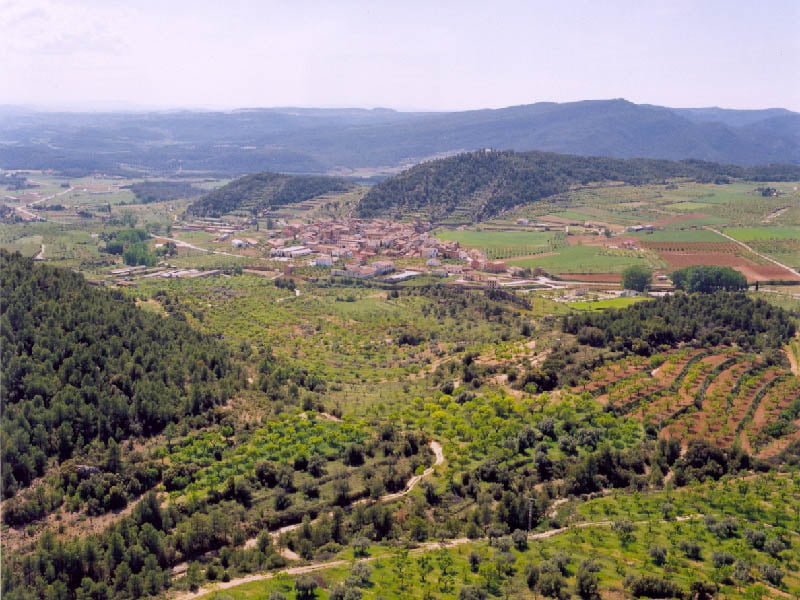
Fuentespalda, known in Catalan as Fondespatla, is one of those villages that perfectly encapsulates the spirit of Matarraña: powerful landscapes, well-preserved medieval heritage and a rural calm that invites you to stay longer than planned. Located in the east of the province of Teruel, in the north of the Matarraña region, this small Aragonese municipality is set in a mountainous environment of great natural wealth, between the Pena and Tastavins rivers, at an altitude of over 700 metres above sea level.
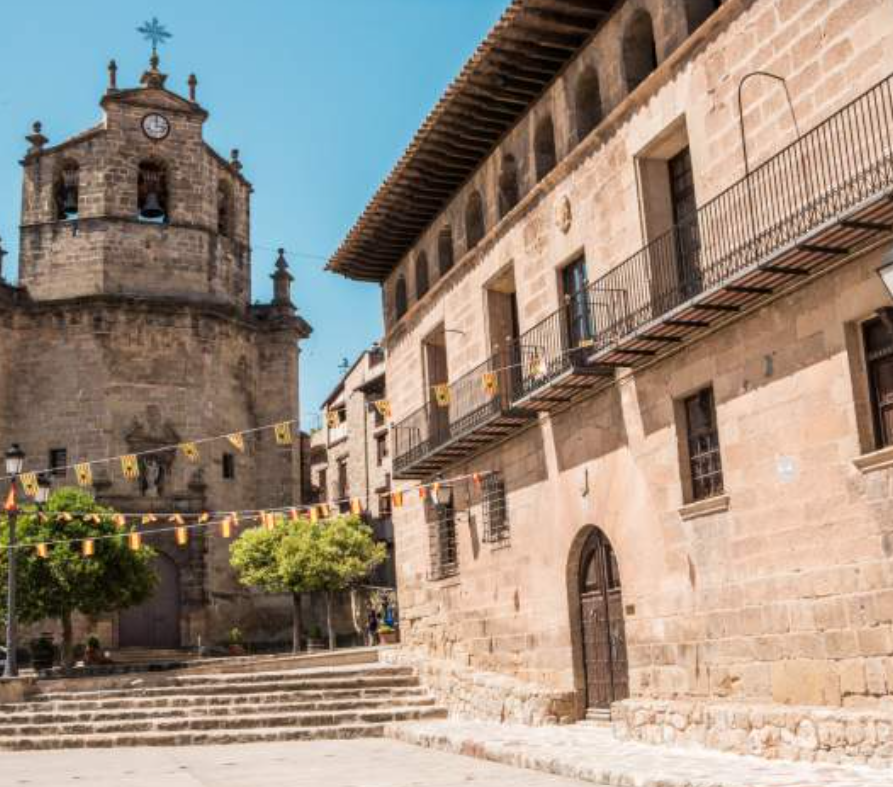
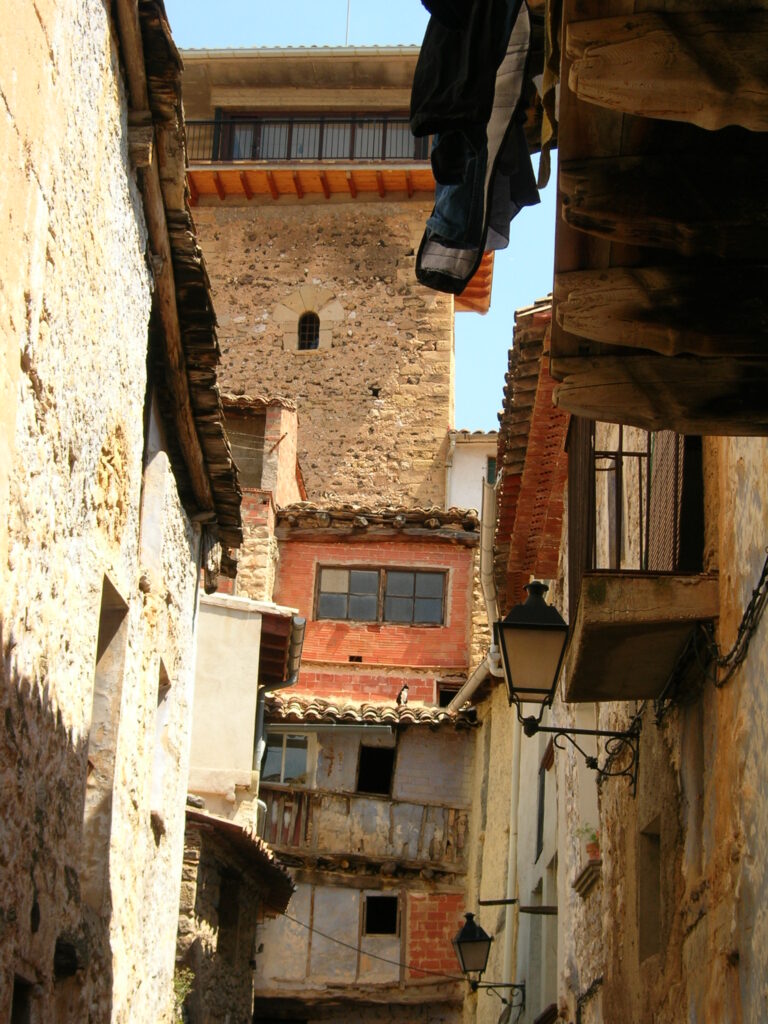
With just over 300 inhabitants, Fuentespalda has preserved a compact town centre with a clearly medieval layout that has hardly changed over the centuries. Its narrow streets, stone houses, defensive gateways and the imposing tower that dominates the town make a stroll through the village a real journey back in time. Added to all this is a privileged, well-preserved natural environment, which forms part of the area of influence of Els Ports de Tortosa-Beceite, one of the most spectacular natural spaces in the north-east of the peninsula.

Where is Fuentespalda and what is its environment like?
Fuentespalda is located less than 200 kilometres from Zaragoza and just over 100 kilometres from the city of Teruel. The most common access is via the road linking Valderrobres with Monroyo, considered by many to be one of the most beautiful routes in the entire region. As travellers approach the village, the landscape becomes more rugged, with rocky mountains, ravines and wide panoramic views that give a foretaste of the mountainous nature of the area.
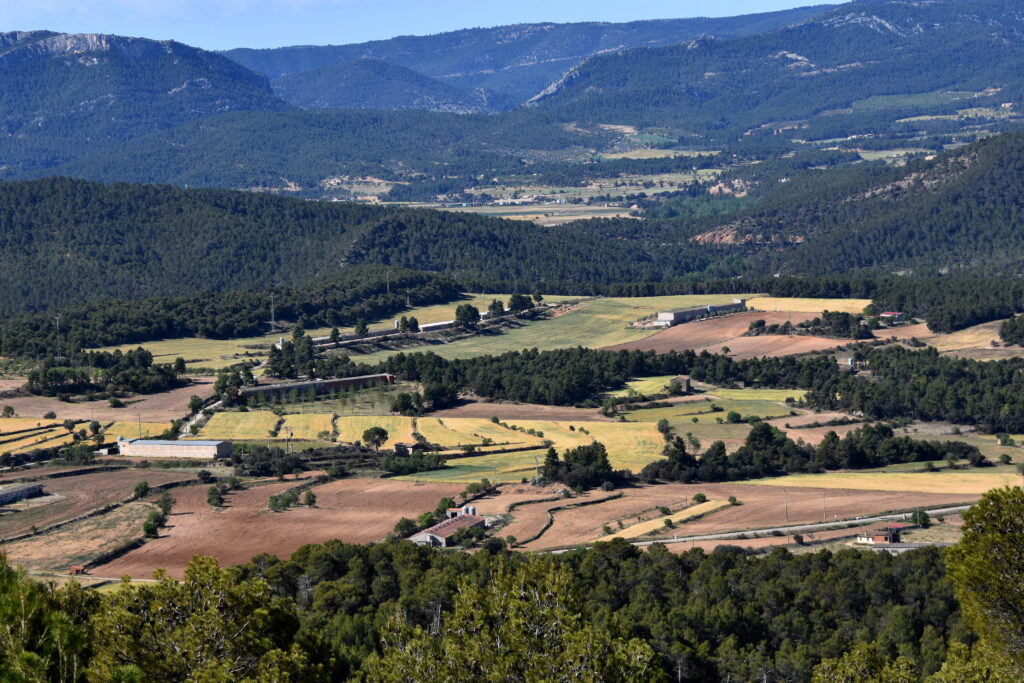
The municipal area, covering some 38 square kilometres, has a remarkable geological diversity. Fuentespalda is located at the confluence of three large morphostructural units in the north-east of the peninsula: the Iberian system, the Mediterranean system and the Ebro depression. This uniqueness translates into a rugged relief and a great variety of landscapes.
To the east of the town centre lies a large wooded area dominated by Aleppo pines, where it is not uncommon to spot Spanish ibex. At the bottom of the valley, the River Tastavins brings coolness and riverside vegetation, contrasting with the fields of cereal crops, almond trees and olive trees that form an inseparable part of the traditional agricultural landscape of Matarraña.
The origin of the name and a very ancient past
The name Fuentespalda has given rise to a curious popular legend, according to which, at any point in the village, one always has one’s back to a fountain. However, the explanation most accepted by scholars points to a Latin origin, related to the terms Foz or Spatula, which would refer to a widening valley.
The history of the settlement of Fuentespalda dates back to ancient times. Prehistoric and Roman remains have been found in the municipal area, and it is believed that the Roman settlement of Vila Vella may have been the direct predecessor of the current town. Later, Iberians, Romans and Muslims left their mark on these lands.
After the Christian Reconquest in the 12th century, it was granted a town charter and the medieval town we know today began to take shape. For centuries, Fuentespalda depended on Valderrobres and the Bishopric of Zaragoza, until in the 17th century it achieved administrative independence and had its own town council. Geographical isolation and armed conflicts marked the life of the town for a long time, causing slow development and, in the 20th century, a marked rural exodus. In recent decades, the boost to rural tourism and the revaluation of heritage have contributed to a slow but steady recovery.
The historic centre: a well-preserved medieval complex
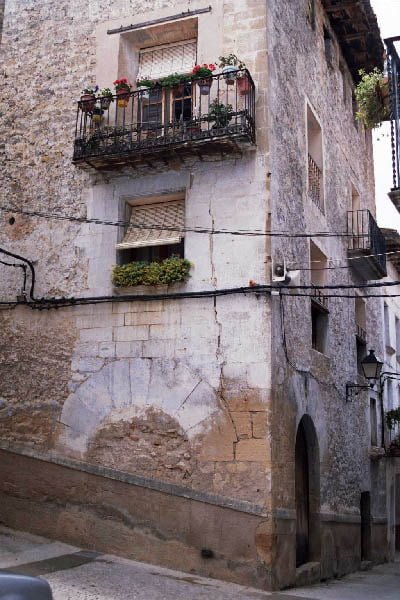
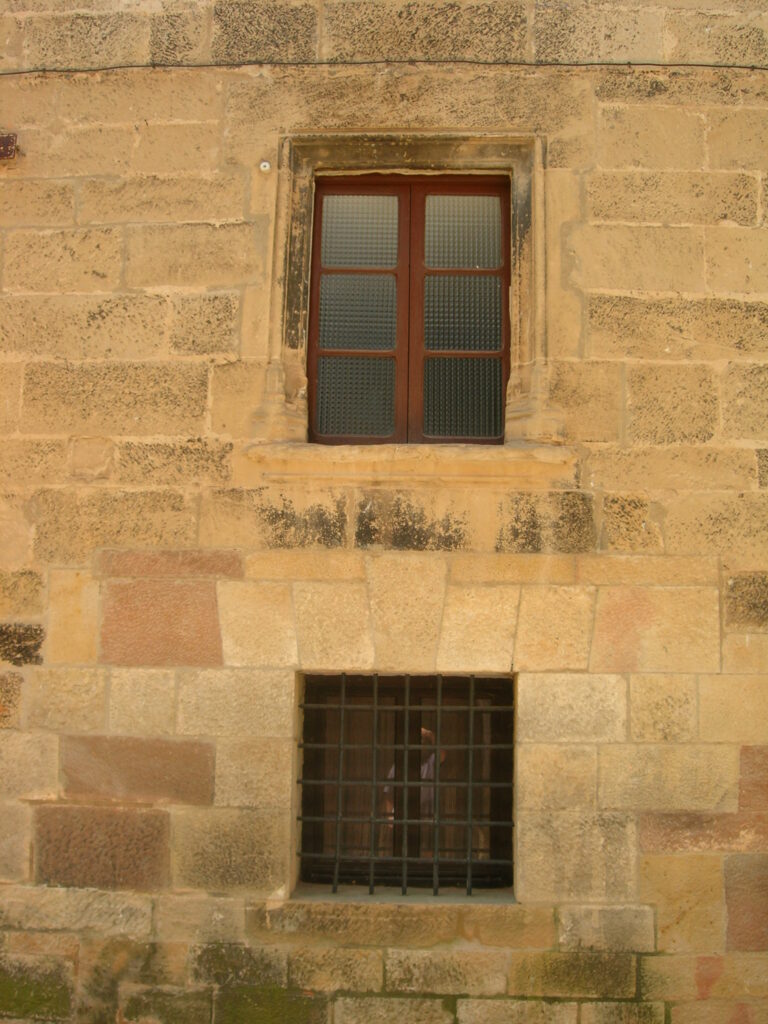
The town centre of Fuentespalda faithfully preserves the structure of the old walled town. Walking through its streets, you can sense the layout of the defensive enclosure, the old entrance gates and the organisation of the medieval urban space. Stone façades, keystone doorways, coats of arms and remains of traditional plasterwork coexist with buildings that have been restored with great respect for the original architecture.
Its narrow streets were not designed for tourism, but for defence and community life. Of the four gateways that guarded the entrance, two survive today: San Francisco and San Antonio. The latter is particularly fascinating, as a Baroque chapel was built over its medieval arch in the 18th century, a distinctive architectural feature of the region that elevates the sacred above the everyday.
The parish church of El Salvador and its historic organ
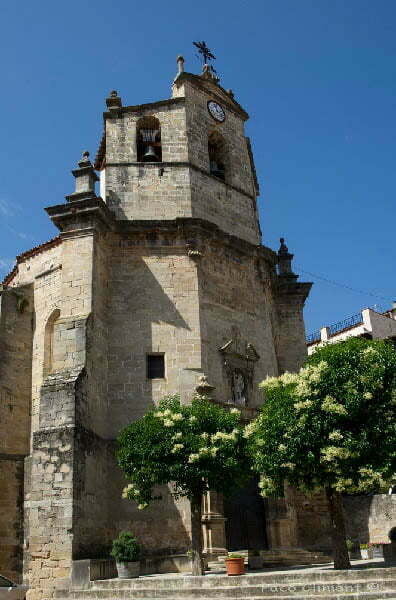
The spiritual epicentre is undoubtedly the Church of El Salvador. Located at one end of the Plaza de España, its architecture is a diary of the aesthetic changes in Aragon. Originally Gothic from the 14th century, under the patronage of the archbishops of Zaragoza, the church underwent a radical transformation in the 17th century. What was once the apse became the entrance, now crowned by an imposing bell gable.
But the real treasure is hidden in the choir. There rests a Baroque organ from 1680, a piece of musical engineering restored in 1993 that continues to fill the stone naves with a sound that seems to travel from the past. Its profusely decorated wooden case is one of the most exquisite examples of Teruel’s liturgical art, enlarged in its day by the famous Francisco Turull.
The Town Hall, the historical archive and the carving of San Miguel
A few steps away, the Town Hall presents itself with the austerity typical of 16th-century stonework. Unlike other neighbouring municipalities, it does not have an adjoining market, but its interior holds secrets that defy conventional history. The municipal archive houses 148 parchments, one of the richest documentary collections in the Matarraña region.
However, the piece that attracts all the attention is the Gothic carving of Saint Michael. Unlike traditional iconography, where the archangel crushes a dragon, here Saint Michael has a goose at his feet. This detail has fuelled theories about the influence of the Order of the Temple in the area, as the goose was a sacred animal for the Templars. Looking closely at the carving, you can see how, in later centuries, attempts were made to “correct” this singularity by adding dragon heads to the original figure, a silent testimony to how institutions sometimes try to erase traces of the heterodox.
La Torreta, symbol of Fuentespalda
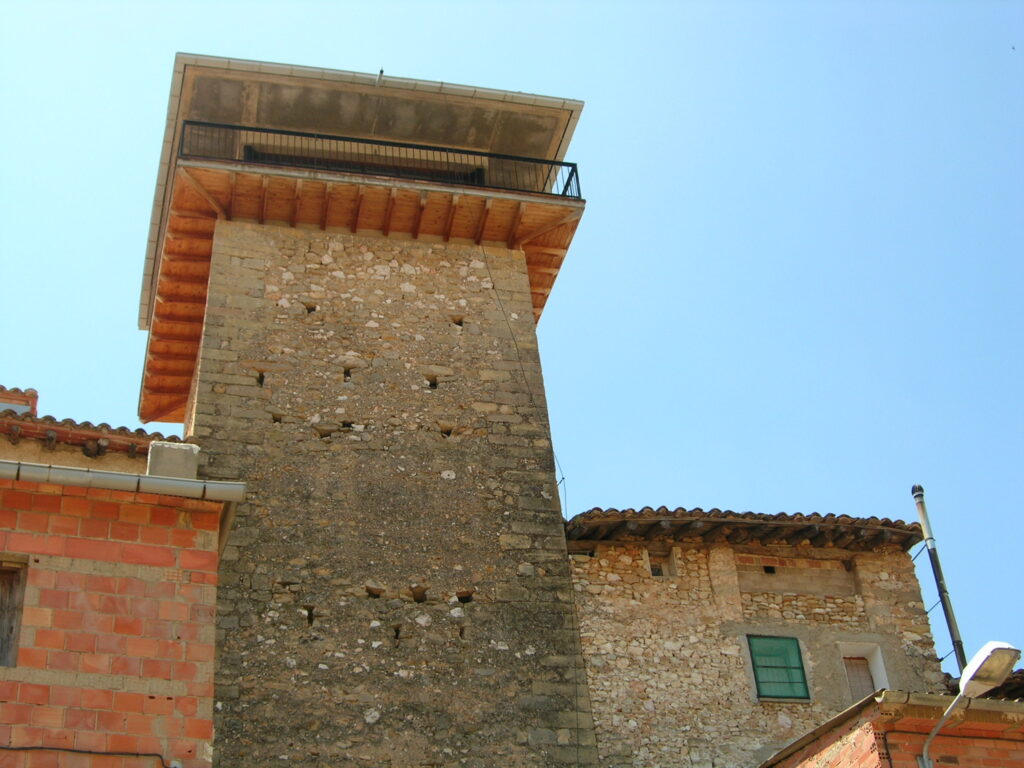
Dominating the skyline of the village from the highest point of the town centre is La Torreta, the great emblem of Fuentespalda. This imposing watchtower, probably built in the 15th century, was part of the defensive system of the medieval town, which was completely walled.
Rectangular in shape and built of ashlar and masonry, La Torreta has solid walls and few openings to the outside, reinforcing its defensive character. In the 19th century, it was used as a prison, and a complete set of original chains and shackles, unique on the so-called Matarraña prison route, is still preserved on the ground floor.
Following its restoration, the building now houses the Matarraña towers interpretation centre and several exhibition rooms. Its viewpoint offers exceptional views of the town centre and the landscape surrounding Fuentespalda.
The medieval cemetery and disc-shaped steles
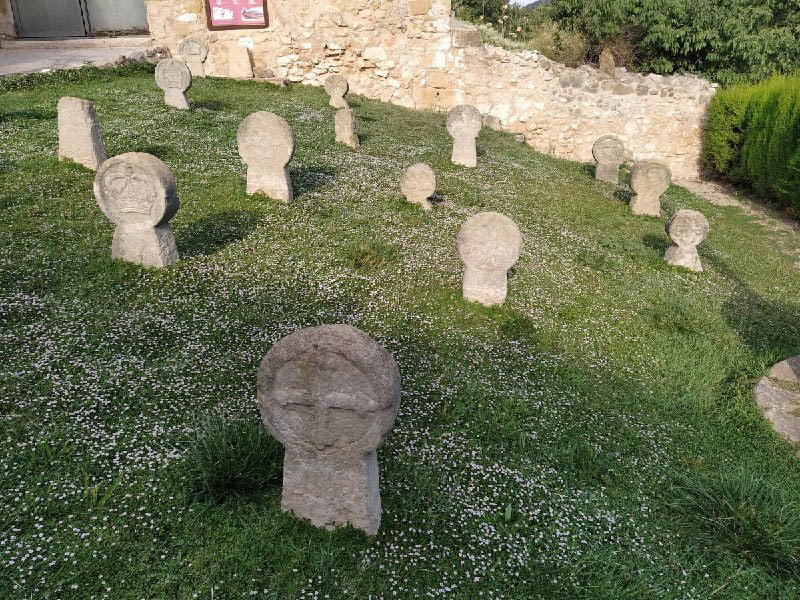
One of the most unique projects in Fuentespalda is the recreation of its medieval cemetery. In a space of just 120 square metres, around twenty disc-shaped funerary steles have been gathered and consolidated. These stone pieces, which crowned tombs in the Modern Age, are laden with symbolism.
These steles, probably made between the 16th and 18th centuries in a local workshop, display a rich iconography related to the Dance of Death, with representations of skeletons, skulls, religious headdresses and royal crowns, symbolising the equality of all men in the face of death. The recreated space provides a better understanding of what rural cemeteries were like in the Modern Age.
Fountains, washing places and hydraulic heritage
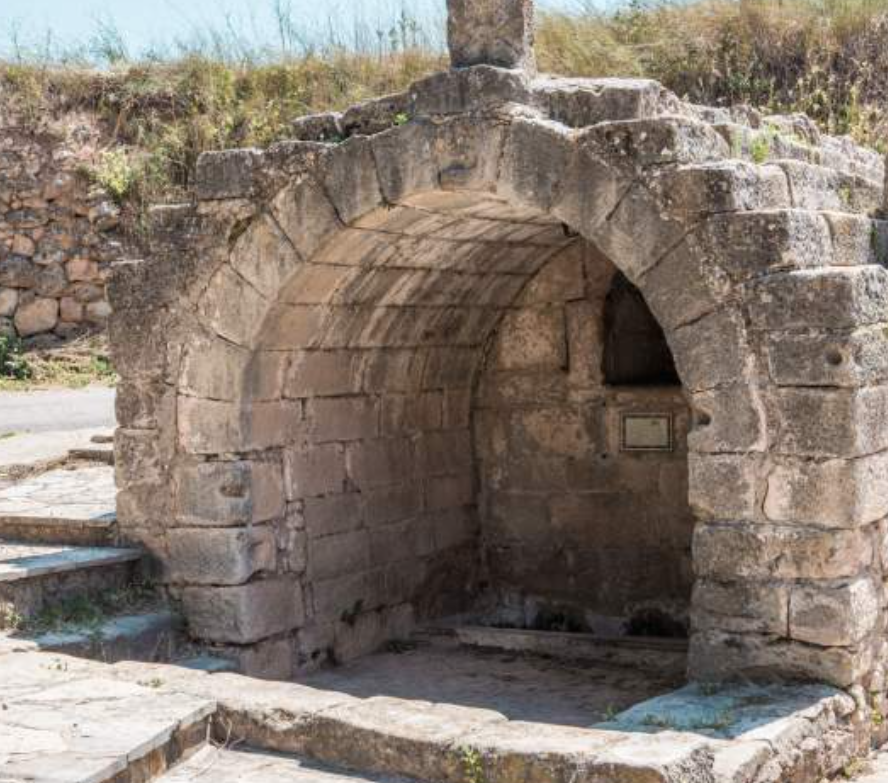
As its name suggests, water is the backbone of Fuentespalda. The Fuente de la Vila is a perfect example of the Renaissance model of water management: a fountain for human consumption, a trough for livestock and a washing place for the community, always in that hierarchical order. Until a few decades ago, this space was the centre of social life for the women of the village.
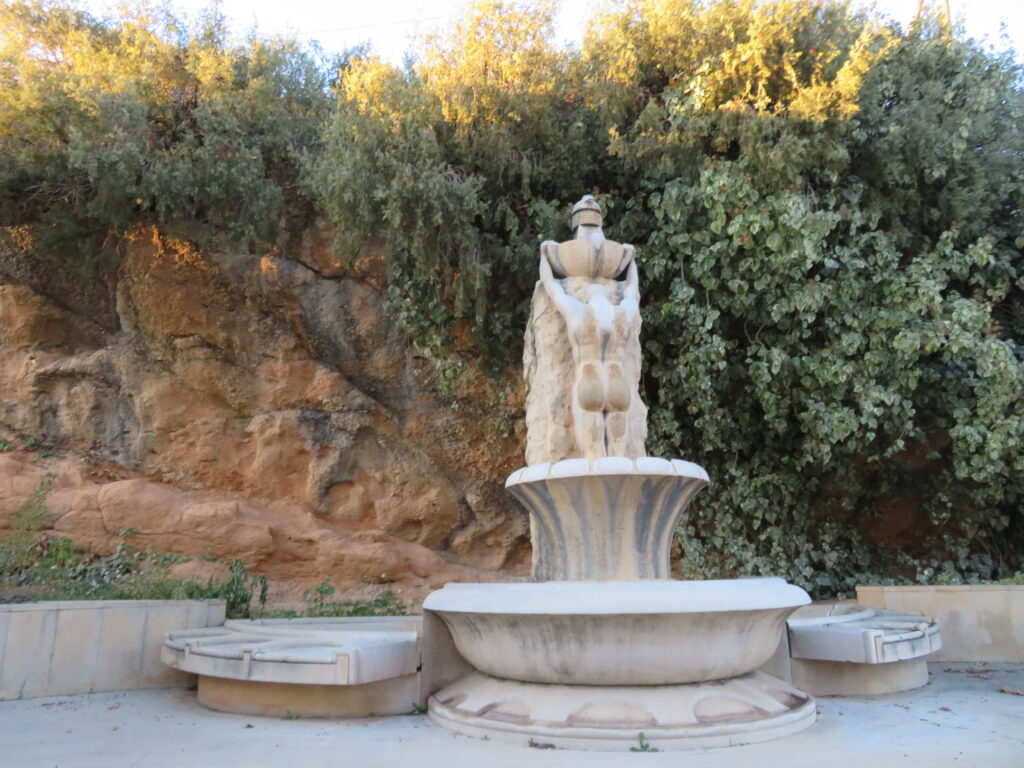
Nearby, the Fuente de la Canyella fountain, with its pointed arch, takes us back to an older Gothic origin, reminding us that the use of natural resources has been a constant for centuries.
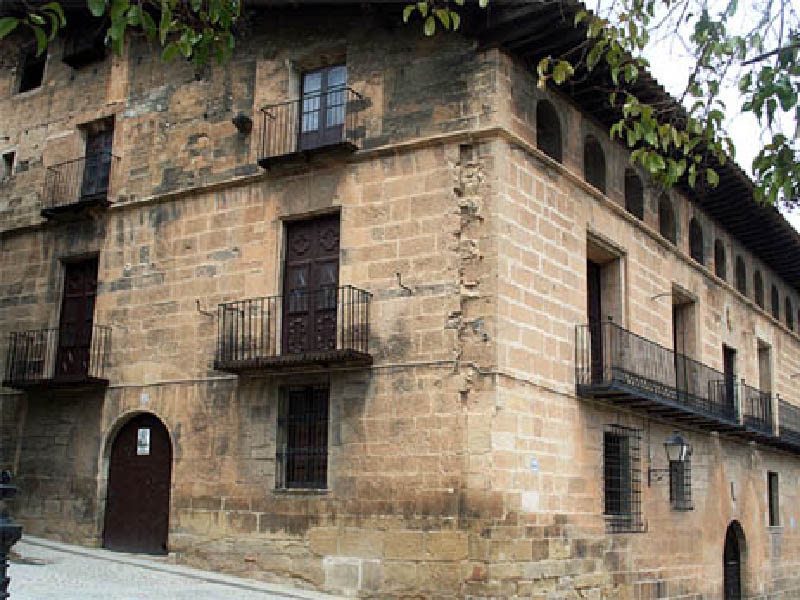
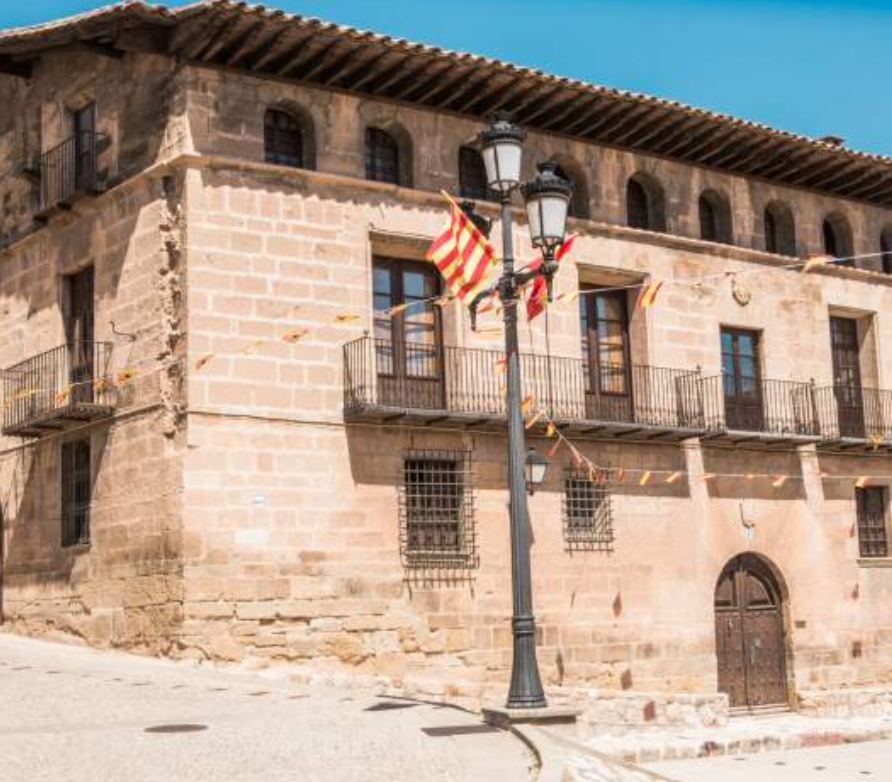
In terms of civil architecture, the Casa de los Belsas stands out. Built in 1546, this Renaissance palace with its characteristic gallery of Aragonese arches and wooden eaves is a testament to the power of the local nobility. Not far away, the Horno del Concejo (Council Oven) preserves the episcopal coat of arms of the Bishop of Zaragoza, reminding us that, for a long time, the residents’ bread depended on the ecclesiastical lordship.
Gateways, chapels and other charming spots
Of the ancient gateways to the medieval wall, the gateways of San Antonio and San Francisco have been preserved. The former is particularly unique, as a Baroque chapel with a wooden roof was built over the gateway in the 18th century, creating one of the most original elements of the region’s heritage.
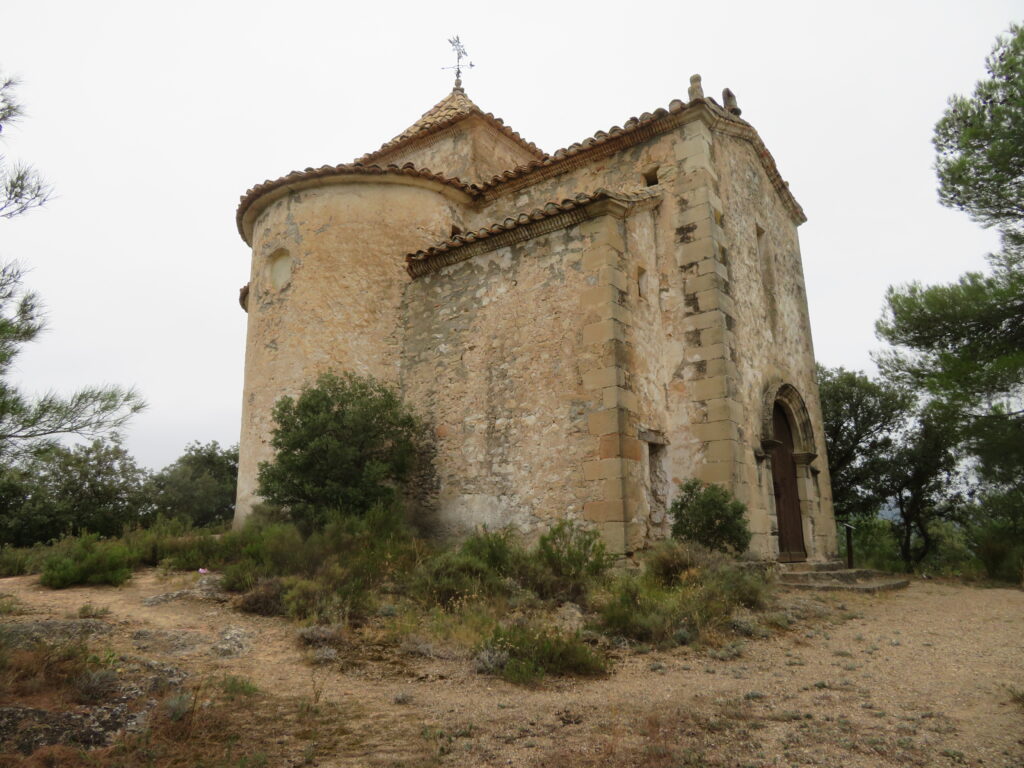
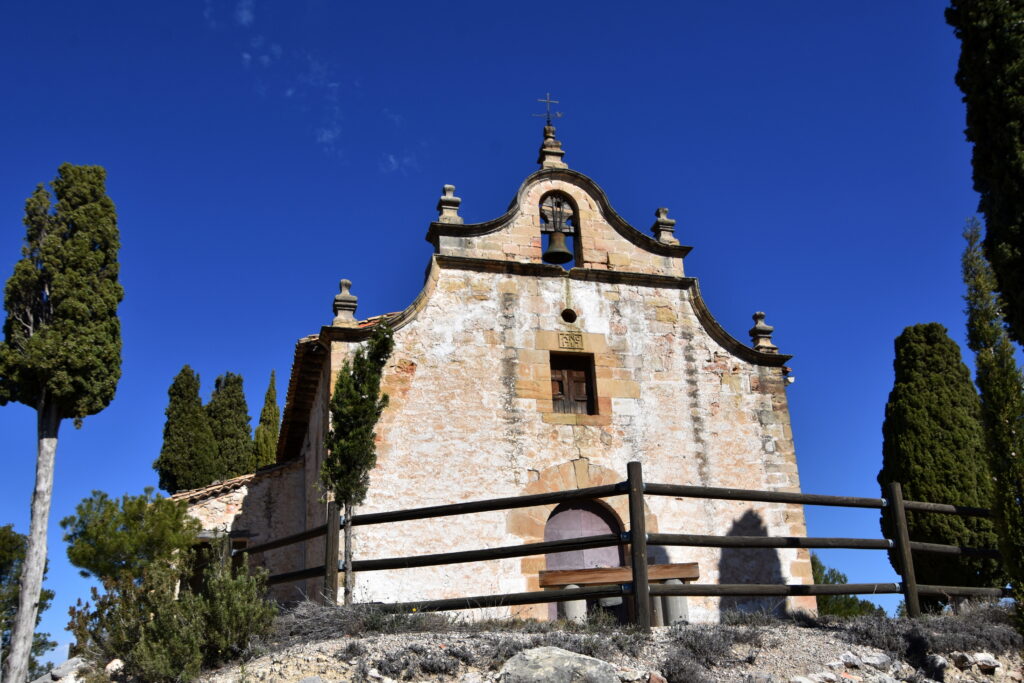
There are several chapels in the vicinity of the village, such as San Pedro Mártir, San Miguel and Santa Bárbara. The 18th-century chapel of San Pedro Mártir celebrates its pilgrimage on the Saturday closest to 28th April. It preserves interesting historical graffiti and is located next to the remains of an old oil mill. Every year, a pilgrimage is held in honour of the saint. The Baroque-style chapel of San Miguel is the focus of another pilgrimage on 29th September, a festive day on which pastries and wine are distributed among those attending.
The Natural Environment: From Cave Paintings to Mountain Passes
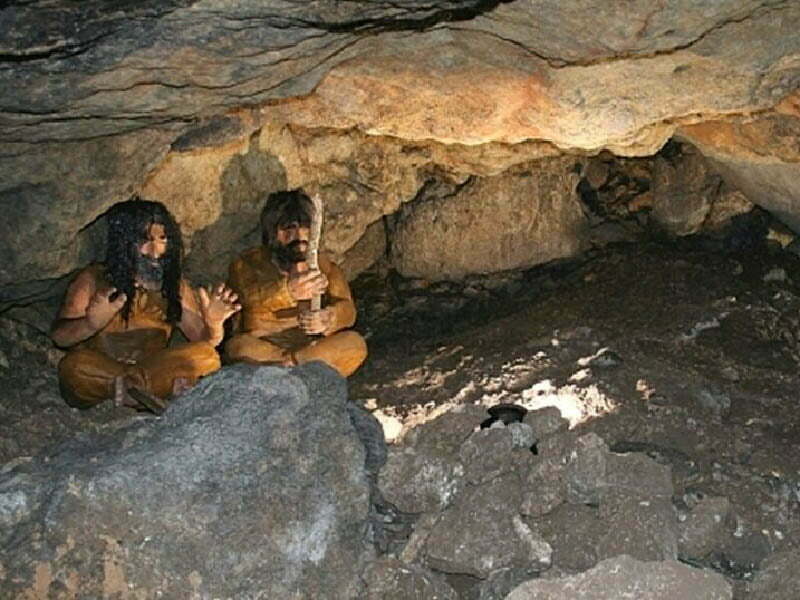
Fuentespalda is also a gateway to prehistory and wild nature. About 3.5 kilometres away are the cave paintings of Vall dels Figuerals, part of the Mediterranean Arc, a World Heritage Site. Although only the figure of an animal (possibly a deer or a goat) is clearly preserved, the place invites reflection on the millennia of human occupation in these lands.
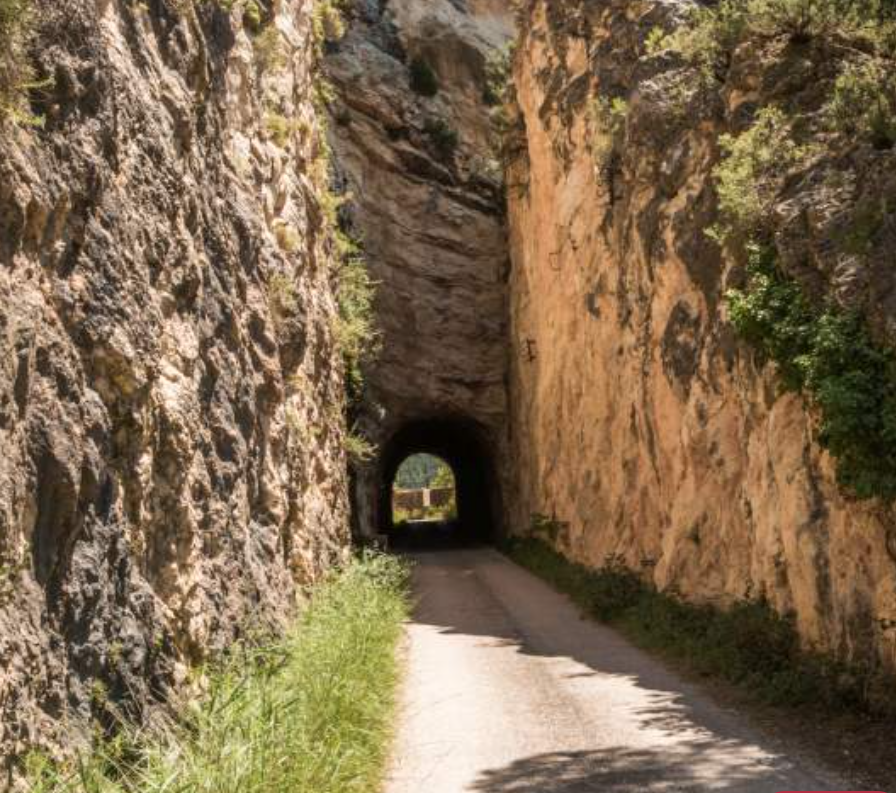
For hiking enthusiasts, the proximity of the Puertos de Beceite mountain passes is an irresistible attraction. Routes such as the Parrizal or the ascent to the limestone ridges offer landscapes that are every bit as impressive as the great mountain ranges. It is a territory where the Tastavins River has carved out corners of rugged and primitive beauty, ideal for losing yourself for a whole day before returning to the refuge of the village.
The Fuentespalda zip line: adrenaline in the Matarraña
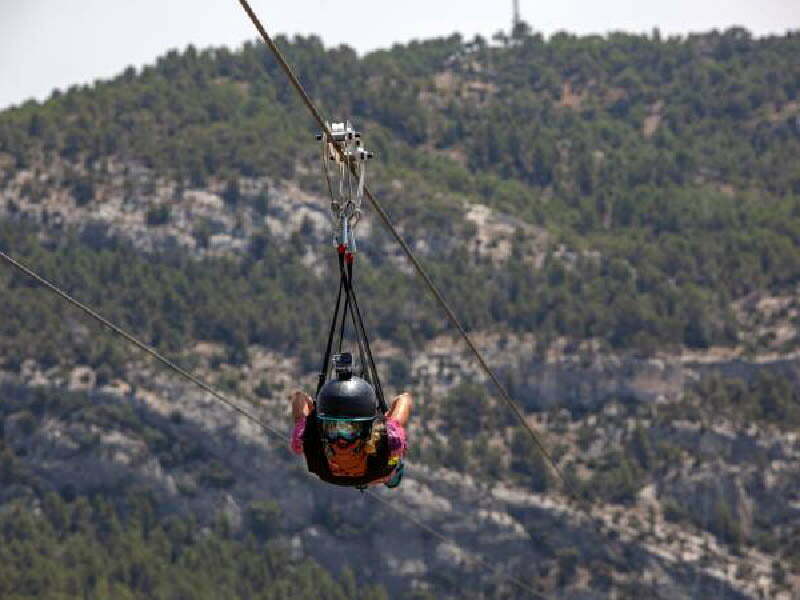
One of the most recent and surprising attractions in Fuentespalda is its spectacular zip line, considered the longest in Spain. At nearly two kilometres long and with a drop of around 200 metres, it offers a unique experience flying over the Matarraña landscape.
The zip line is double, allowing two people to launch simultaneously, and has all the necessary safety measures in place. It even has equipment adapted for people with reduced mobility, making it an accessible activity. There is also the possibility of night-time jumps, a completely different experience.
Additional information:
- The departure point is from the village of Fuentespalda itself.
- The company in charge of the attraction is responsible for taking people who want to do the activity to the start of the zip line and picking them up at the end.
- You must arrive at least half an hour in advance, and it is advisable to book in advance via their website.
- The manoeuvring and safety equipment is provided on site by the company itself.
Gastronomy and local life
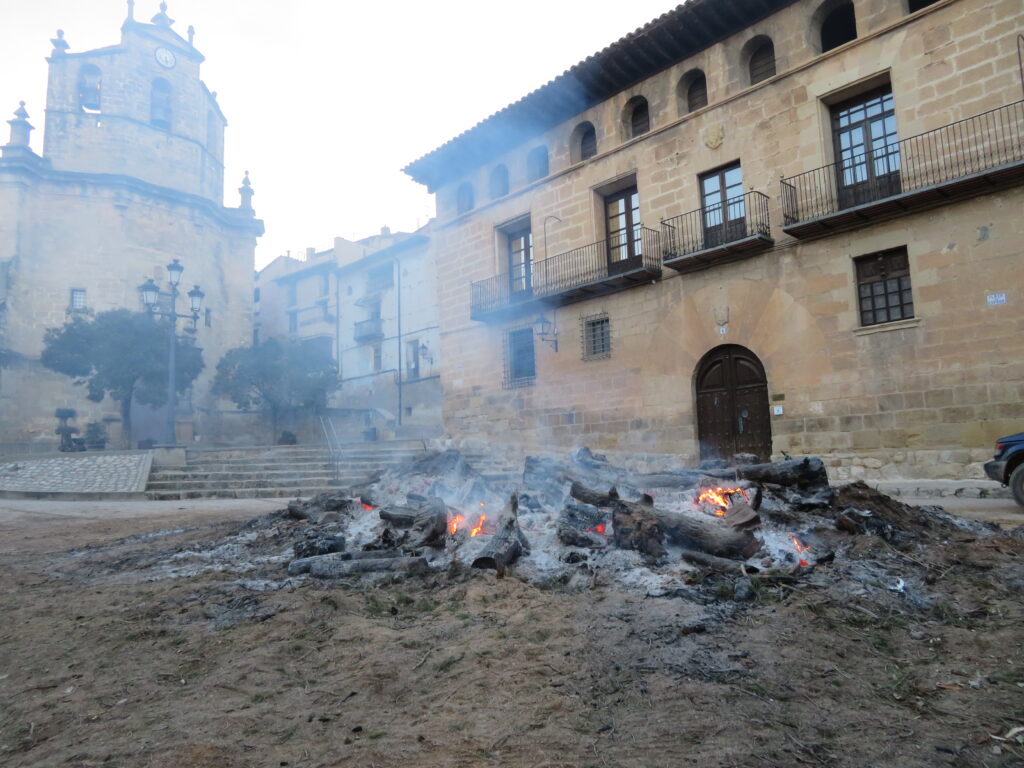
You cannot understand Fuentespalda without sitting down to eat. Its economy, based on dry farming and pig farming, dictates the menu. The star product is the almond (varieties such as Marcona and Largueta), which is the basis of exquisite traditional pastries. Secalls, atmellats and crespells are essential snacks that encapsulate the flavour of the land.
Roast Aragon lamb and pork sausages (Teruel ham, chorizo, longaniza) are the mainstays of the heartiest meals. All this is washed down with local wines, which in recent years have gained international prestige thanks to the recovery of local varieties and minimal intervention viticulture.
Practical Guide for Travellers
- Best time to visit: Spring and autumn offer the most pleasant temperatures for hiking and the clearest light for photography.
- How to get there: The road between Valderrobres and Monroyo is possibly the most spectacular in Matarraña. Fuentespalda is strategically located on this route.
- Essential: Book in advance if you want to try the zip line, especially on weekends and public holidays.
- What to try: Typical sweets such as secalls and, of course, Teruel ham with designation of origin.
Discover Teruel
Here are some more places we have marked on the map in Teruel, so you can add them to your itinerary. We have also included the distances by car from each location:
- Cantavieja: discover this beautiful medieval village.
- Calaceite: visit this medieval village, listed as one of the ‘Most Beautiful Villages in Spain’.
- Mirambel: a medieval walled town declared a Historic-Artistic Site.
- Peñarroya de Tastavins: medieval village among dinosaurs and mountains.
- Castellote: visit this village with its impressive Templar castle.
- Puertomingalvo: another medieval village belonging to the network of ‘The Most Beautiful Villages in Spain’.
- Monroyo: medieval village with many hiking trails.
- Sarrión: world capital of black truffles.
Why visit Fuentespalda
Fuentespalda is an ideal destination for those seeking tranquillity, heritage and unspoilt nature. Its historic centre, dominated by the Torreta, the church of El Salvador and the Town Hall, retains its medieval character intact. Its natural surroundings invite you to take a leisurely stroll, and its traditions, festivals and gastronomy reflect a slow-paced and authentic way of life.
Visiting Fuentespalda means discovering one of the villages with the most personality in Matarraña, a place where history, landscape and rural life combine to offer a genuine experience, very much in line with the destinations that make this region one of the most attractive in Aragon.
Photo Credits
Below are the photo credits in order of appearance. Royalty-free photos will not be listed below:
- Cover Image: Juan Emilio Prades Bel, CC BY 4.0, via Wikimedia Commons
- Turismo de Aragón, via turismodearagon.com
- Angela Llop, CC BY-SA 2.0, via Wikimedia Commons
- Así es Aragón, via turismoenaragon.com
- Así es Aragón, via turismoenaragon.com
- Así es Aragón, via turismoenaragon.com
- Enfo, CC BY-SA 3.0, via Wikimedia Commons
- Así es Aragón, via turismoenaragon.com
- Turismo de Aragón, via turismodearagon.com
- Enfo, CC BY-SA 3.0, via Wikimedia Commons
- Así es Aragón, via turismoenaragon.com
- Juan Emilio Prades Bel, CC BY 4.0, via Wikimedia Commons
- Turismo de Aragón, via turismodearagon.com
- Juan Emilio Prades Bel, CC BY-SA 4.0, via Wikimedia Commons
- Angela Llop, CC BY-SA 2.0, via Wikimedia Commons
- Así es Aragón, via turismoenaragon.com
- Turismo de Aragón, via turismodearagon.com
- Así es Aragón, via turismoenaragon.com
- Enfo, CC BY-SA 3.0, via Wikimedia Commons