What to see in Huércal-Overa (Almería): history, heritage and unmissable experiences
Huércal-Overa is one of those places in Almería that surprises you much more than you might imagine before you arrive. Located in the far north-east of the province, right on the border with Murcia, over the centuries this town has become a strategic point between Levante and Andalusia. It is a region where the arid landscape of south-eastern Spain coexists with fertile orchards, and where history can be read in each of its streets, towers, temples and fortresses.

Today, the city is the capital of the Levante Almeriense region and a hub of services, commerce and cultural life that attracts more and more visitors. And it’s no wonder: Huércal-Overa combines heritage, tradition, gastronomy, museums, nature and one of the most important events in Almería: its Holy Week, declared a Festival of National Tourist Interest.

If you are planning a route through Almería or looking for a stopover with character between Murcia and the south of the peninsula, here is a complete guide to discovering Huércal-Overa: its history, its most representative monuments and the best experiences to enjoy it to the full.

A privileged enclave between Almería and Murcia
Huércal-Overa stretches between two ravines that descend from the Almanzora River, forming a landscape that is very characteristic of eastern Almería: fertile orchards where the water reaches, and arid, scrubby hills as soon as you move away from the riverbank.
This strategic position explains why civilisations such as the Phoenicians, Greeks, Romans, Muslims and Christians have left their mark here.

It also explains why the town soon became a key commercial centre, a role it still plays today. You only have to visit the market on any Monday to see this: much of the town centre is filled with stalls, shoppers and a very local atmosphere that has been part of its identity for centuries.
In addition, its proximity to the Mediterranean motorway and its wide range of services — hotels, restaurants, hospital, sports facilities, cultural centres — make Huércal-Overa a perfect base for exploring the region or for a half-day visit as part of a wider tour of Almería.
A journey through the history of Huércal-Overa
Origins and antiquity
Although the current name comes from the union of two ancient settlements, Huércal and Overa, documented after the repopulation of the 16th century, the territory was inhabited much earlier.
Phoenicians and Greeks passed through here in search of minerals; Carthaginians and Romans consolidated their exploitation and presence in the area. One of the most unique places linked to this period is the Cueva de Escipión (Scipio’s Cave) in Cabezo de la Jara, associated with episodes of warfare between Roman and Carthaginian generals. Later, Augustus integrated the region into the province of Tarraconensis, along with enclaves such as Purchena and Vélez Rubio.

Al-Andalus period: castles and territorial defence
The direct origin of Huércal-Overa as an urban centre lies in Al-Andalus. During this period, two key fortifications were built:
- The Arab castle of Huércal, today its most emblematic monument.
- The castle of Santa Bárbara de Overa, which visually dominated much of the area.
Both were part of a defensive system that protected the eastern end of the Nasrid Kingdom of Granada.

Christian conquest and repopulation
After being annexed in 1488 and donated to the city of Lorca, the population was greatly reduced. The Moriscos of Overa left so as not to renounce their faith and, after the War of the Alpujarras, a repopulation was organised between 1572 and 1573, unifying the two centres under the same municipality.
In 1668, Huércal-Overa gained its independence from Lorca, adopting the name it still bears today.
From the 19th century to the present day
The 19th century was a period of remarkable demographic expansion: from just over 2,000 inhabitants in 1805, the population grew to more than 15,600 in 1887, including both the countryside and the urban centre. This prosperity led to the construction of civil, religious and residential buildings that today form an essential part of the local heritage.

In the 20th century, conflicts such as the Civil War left their mark on the landscape, with trenches that can still be visited in the surrounding area. From the 1970s onwards, a period of recovery began, attracting writers and travellers such as Virginia Woolf, Juan Goytisolo and Gerald Brenan, who were interested in the charm and authenticity of the Almeria coast.
What to see in Huércal-Overa: essential places
Below is a complete tour of the main points of interest in Huércal-Overa, ideal for organising a day trip or a longer getaway.
1. Huércal-Overa Castle
If there is one symbol that epitomises the town, it is its castle. Declared a Site of Cultural Interest, it dominates the landscape from the top of a hill and can be seen from miles away before reaching the town.
Contrary to what was traditionally thought, recent excavations have confirmed that it was not just a watchtower, but a hisn: a complete fortification with walls, attached towers and intramural spaces. The enclosure was rectangular in shape, adapted to the terrain, with a large tower on the north wall and defensive towers at the corners.

One of its most special features is the Tree of Life, a geometric motif incised in stucco found on one of the walls of the third floor. This representation, fundamental in Islamic iconography, symbolises the connection between the human and the divine and has only been documented in very few fortresses on the peninsula. The other comparable example is found in the Gibralfaro Castle in Malaga.
Visiting the castle is easy and inexpensive:
General admission: €1
Children: €0.50
Upcoming archaeological work will allow for the recovery of even more sections of the castle, making it a heritage landmark in eastern Almería.

2. The Parish Church of Nuestra Señora de la Asunción
Located in the heart of the town, this 18th-century church is one of the most spectacular buildings in Huércal-Overa. Its construction began in 1709 and was completed in 1739, resulting in a monumental temple consisting of:
- A central nave covered by a barrel vault.
- Two towers framing its façade.
- A main altarpiece of remarkable artistic value.
Declared an Andalusian Historical Heritage Site, admission is free and it is one of the best examples of religious architecture in eastern Almería.

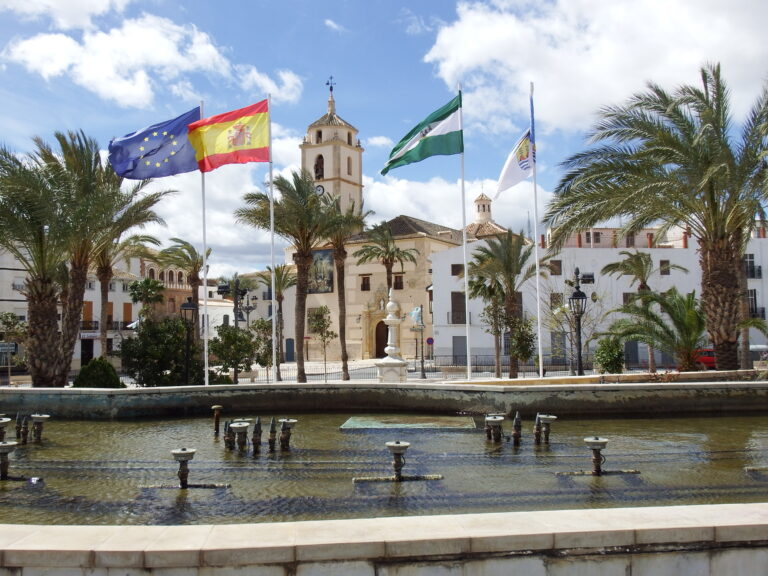
3. Plaza Mayor or Plaza de la Constitución
This is the social heart of Huércal-Overa: a lively place with terraces, shops and a very local atmosphere. If you visit the city on a Monday morning, you will find a large part of the traditional weekly market here, which completely transforms the city centre.
The square is the ideal place to start a tour of the town’s monuments and museums.

4. Old Town Hall (Palace of Justice)
This elegant building is part of the historic centre. Its 19th-century civil architecture reflects the period of economic and social expansion experienced by Huércal-Overa at that time.

5. The Four Towers Building
Dating from the late 19th century, this small palace is another of the municipality’s great architectural landmarks. Its uniqueness and design make it an icon for lovers of historicist architecture.

6. The Ethnographic Museum and the Water Museum
Two spaces that provide a direct insight into how the inhabitants of Huércal-Overa lived over the centuries. The first exhibits everyday objects and traditional utensils; the second focuses on water management, a key resource for understanding life in this semi-desert area.

7. Óleo Jarico: EVOO culture
The perfect visit for olive oil lovers. At Óleo Jarico you can discover how top-quality EVOO is made, learn about local varieties and learn to distinguish aromas and flavours. An excellent gastronomic experience to round off your visit.

8. Villa de Huércal-Overa Theatre
This modern cultural space, with a white Macael marble façade, contrasts with the age of the fortresses and historic buildings. The theatre hosts events, shows and cultural activities throughout the year.

9. Huércal-Overa Greenway
One of the best options for travellers looking for nature and outdoor routes.
The greenway follows the route of the old Almanzora railway, now disused, and connects Almajalejo with Las Norias. It is 17 kilometres long and perfectly equipped with:
- Rest areas
- Information panels
- Viewpoints
- Bicycle parking
It is an ideal route for walking or cycling, especially at sunset when the light enhances the arid landscape and the surrounding ravines.

10. Adolfo Suárez Park
A green space of more than 1,900 m², perfect for resting after exploring the city. It has children’s play areas, street furniture and an interesting collection of birds and plant species.

11. Santa Bárbara Castle
Located on a hill with panoramic views, this 13th-century castle was part of the Nasrid defence on the eastern border of the Kingdom of Granada. Although it is now in ruins, it is an evocative place and recommended for those who enjoy exploring historic watchtowers and rugged landscapes.

Holy Week in Huércal-Overa: a unique event in Almería
One cannot talk about Huércal-Overa without mentioning its Holy Week. Declared a Festival of National Tourist Interest since 1983, it is one of the most spectacular religious events in the whole of eastern Andalusia.
The processions include images by great sculptors such as:
- Navarro Arteaga
- Castillo Lastrucci
- González Moreno
- Sánchez Lozano
- Salzillo
The streets are filled with music, incense and popular devotion. If you can visit the town at this time of year, the experience is completely different from any other on the Almeria festive calendar.

Gastronomy in Huércal-Overa: flavours from Almeria and Murcia
The local cuisine combines influences from Almeria and Murcia, creating authentic home-style dishes. Some essentials:
- Traditional stews
- Grilled meats
- Garden produce
- Exceptional pastries, especially at Christmas and Easter
If you’re looking for recommendations, two restaurants that are highly regarded by locals and visitors alike are Ballabona and Andalucía, both known for their home cooking and friendly service.
And if you visit Huércal-Overa during the Ruta de la Tapa (Tapas Route), you’ll have the opportunity to sample small gastronomic gems prepared by the town’s bars and restaurants.

Huércal-Overa as a getaway destination
The combination of history, heritage and good road connections makes Huércal-Overa an ideal place for:
- Making a stopover between Almería and Murcia
- Enjoying a weekend getaway
- Exploring the interior of the Levante region
- Discovering castles and unique semi-arid landscapes
- Experiencing deeply rooted traditions
Added to this is its wide range of accommodation, services and leisure facilities, with a municipal swimming pool, sports centres, parks and numerous shops.
Huércal-Overa in summary: 10 reasons to visit
- Its Baroque church of Nuestra Señora de la Asunción
- The Plaza Mayor and the market atmosphere
- An incomparable Holy Week in Levante Almeriense
- The Castle of Huércal-Overa, restored and spectacular
- The modern Villa Theatre
- A rich and varied gastronomy
- The Greenway, perfect for walking or cycling
- The Adolfo Suárez Park
- The Castle of Santa Bárbara, at the top of the hill
- The Tapas Route, which every year brings together the best of local cuisine
Discovering Almería
Visit other places in Almería and add them to your trip, or make a note for future reference:
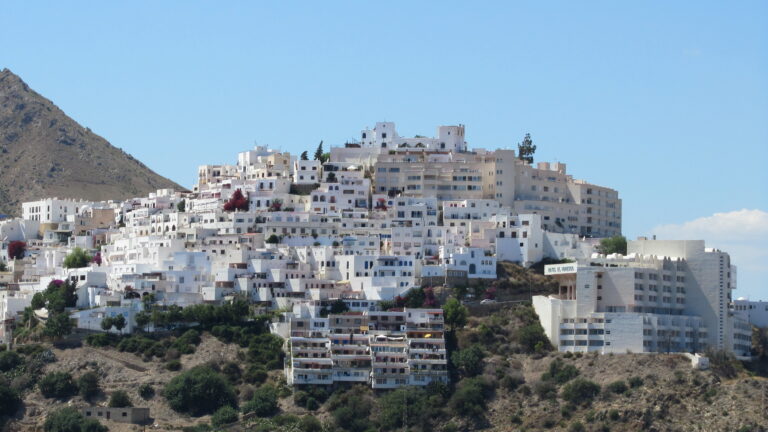
- Mojácar: One of the most beautiful villages in Spain, an essential visit in the region.
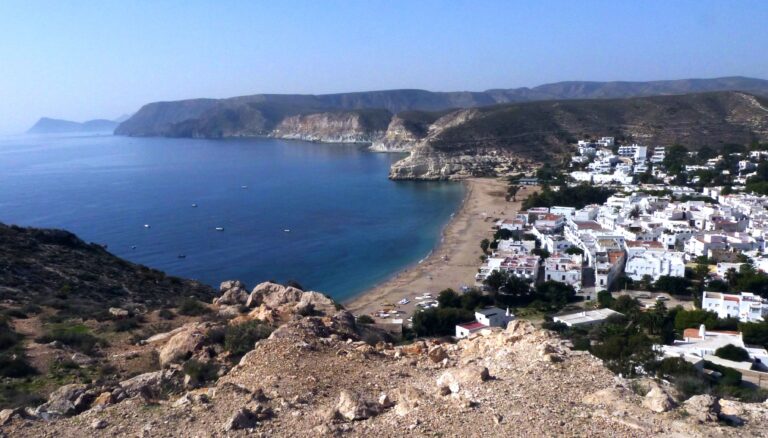
- Agua Amarga: One of the most charming villages on the Almería coast, with its seafaring essence and leisurely pace.
- Garrucha: A place that combines the vibrant modernity of a tourist destination without losing its fishing soul.
- Albox: Home to one of the most impressive monasteries in eastern Andalusia, the Santuario del Saliente.
- San José: Gateway to legendary spots such as Los Genoveses, Mónsul and Media Luna beaches.
Conclusion: a destination steeped in history and authenticity
Huércal-Overa is a municipality that perfectly sums up the character of eastern Almería: a land of contrasts, fertile orchards and luminous deserts, medieval castles and Baroque temples, lively markets, home-style cuisine and exciting celebrations.

If you are planning a trip to Almería, including Huércal-Overa in your itinerary is a wise decision. History, culture, nature and flavour… everything here is presented in a simple, honest and deeply authentic way.
Photo Credits
Below are the photo credits in order of appearance. Royalty-free photos will not be listed below:
- Huércal-Overa Turismo, via turismo.huercal-overa.es
- Ayuntamiento de Huércal-Overa, via huercal-overa.es
- Phillip Mitchell, CC BY 2.0, via Wikimedia Commons
- Wikipuerto, CC BY-SA 3.0, via Wikimedia Commons
- Huércal-Overa Turismo, via turismo.huercal-overa.es
- myalmeria, via myalmeria.com
- Huércal-Overa Turismo, via turismo.huercal-overa.es
- Huércal-Overa Turismo, via turismo.huercal-overa.es
- Huércal-Overa Turismo, via turismo.huercal-overa.es
- 65ymas, via 65ymas.com
- Red Andaluza de Teatros Públicos, via redescena.net
- Huércal-Overa Turismo, via turismo.huercal-overa.es
- Huércal-Overa Turismo, via turismo.huercal-overa.es
- myalmeria, via myalmeria.com
- Gurutzearen martin, CC BY-SA 4.0, via Wikimedia Commons
- LauSalOrc40, CC BY-SA 4.0, via Wikimedia Commons