Agua Amarga in Almería: the white jewel of Cabo de Gata that you’ll fall in love with at first sight
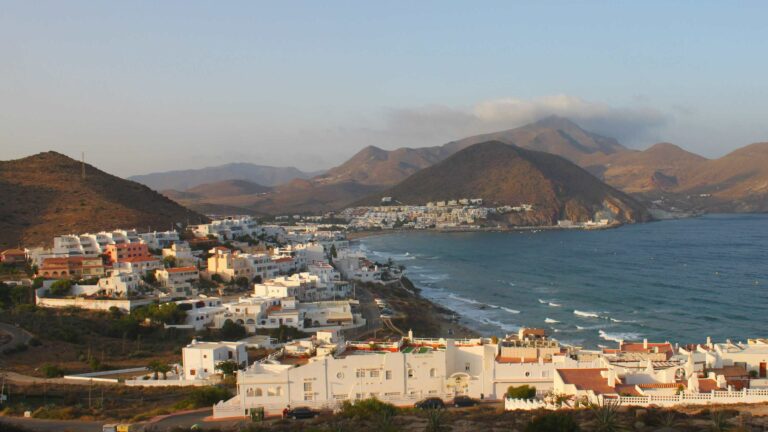
Agua Amarga is one of those places that seems designed to slow you down. A small hamlet in the municipality of Níjar, hidden between arid hills and the crystal-clear Mediterranean, where the white houses, the silence of the Cabo de Gata-Níjar Natural Park and the golden light of the south create an atmosphere that makes you think: ‘I could live here’. Although for years it was a place known only to a few, today it is one of the most charming villages on the Almeria coast, without having lost its seafaring essence or its leisurely pace.

Throughout this guide, we tell you what to see in Agua Amarga, which are its must-see spots, which coves to explore, which routes to take and which plans are best if you are looking for relaxation, nature and picture-perfect landscapes. And, of course, where to eat, because in a village like this, fresh fish reigns supreme.

Welcome to one of the most special places in the Mediterranean.

Agua Amarga, a Mediterranean postcard in the heart of Cabo de Gata
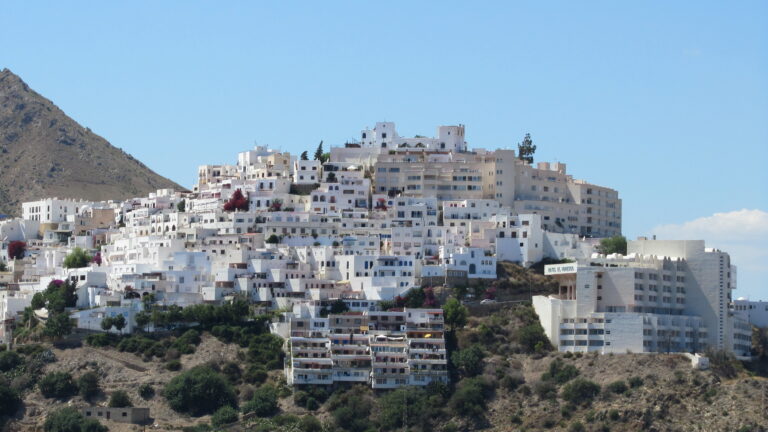
Agua Amarga has managed to strike a difficult but successful balance between the inevitable tourist boom and the preservation of its essence as a fishing village. Unlike other coastal enclaves that have succumbed to uncontrolled urbanisation, here the white houses with their careful architecture predominate, integrated into the landscape and dotted around the surrounding hills.
There are no large hotel complexes, only small, family-run accommodations that foster a more intimate and respectful experience of the environment.

Its narrow and often labyrinthine streets are a visual delight. The lush vegetation, a rarity in this semi-arid climate unique in Europe, bursts into bougainvillea and geraniums peeking out from balconies and terraces. This flowering, especially in spring, enhances the feeling of being in a coastal orchard. These streets converge around the main square – the true social heart of the town – offering a charming space for socialising and enjoyment.
Benches decorated with glazed tiles by artist Matthew Weir invite you to take off your watch and embrace the pure Mediterranean atmosphere where tapas and beer are the only commitment.

The atmosphere in Agua Amarga is undoubtedly chic and bohemian. Small, charming fashion and accessory shops are interspersed with traditional establishments, creating a mix that attracts quality tourism seeking discretion, tranquillity and natural beauty. In fact, the discretion of the environment is such that members of European royalty have made it a favourite destination for relaxation.

If you look closely at the landscape, you will discover part of its history: at the eastern end of the beach, there are still the remains of the old ore loading bay which, since the late 19th century, transported iron from the mines of Lucainena de las Torres to the ships.

On the hill that shelters the village, the ruins of this old loading bay not only tell the story of the ore, but also the lives of the workers who, it is said, lived in the caves of Agua Amarga dug into the hillside of Cerro del Cuartel, caves that would later become a refuge for the hippie community that settled in the area several decades ago, adding a layer of timeless bohemianism to the character of the village.

All around, hills dotted with little houses rise gently, shaping a landscape reminiscent of the Greek islands… but with the soul of Almería.

Agua Amarga Beach: accessible, family-friendly and steeped in history
One of the reasons why Agua Amarga is one of Almería’s favourite destinations is its urban beach. Approximately 660 metres long and considerably wide, this stretch of fine golden sand is the heart of the village.

Classified by the 2008 Natural Resources Management Plan as an area with special regulations (Zone B4), it is a family-friendly beach with crystal-clear, calm waters, protected by rock formations and awarded the Blue Flag and the “Q” for tourist quality. Its sedimentary cliffs are also a point of interest due to their wealth of fossils.

It has all the amenities you could imagine: toilets, showers, litter bins, security, accessibility for people with reduced mobility, restaurants and beach bars. It is a comfortable, family-friendly and very safe beach, perfect for spending the day without a care in the world.

To the west, the beach is bordered by a rocky cliff with small caves that were once dug out by workers who worked on the iron railway. These caves and geological formations are not an isolated phenomenon: they are part of the unique volcanic landscape of Cabo de Gata, an environment where erosion has shaped caves, cornices and rocks that jut out between beaches and coves in an almost surreal way.

If you skirt this cliff in a kayak, you will come to a small cove with a cave that is very popular with visitors for its traditional mud baths. It is not a ‘typical’ tourist attraction, but it is one of those details that give the Agua Amarga coastline its personality.

The best coves near Agua Amarga
The surrounding coastline, however, hides a catalogue of unspoilt and rugged coves that are the true hallmark of Cabo de Gata, accessible on foot or, ideally, by kayak or boat:
Cala de Enmedio: the darling of Cabo de Gata
Just half an hour’s walk from the village, following a path between hills and white limestone, this gem appears: a 150-metre cove, completely unspoilt, with fine sand and crystal-clear waters.

The fossilised dunes on either side and the small natural pools that form in the rocks make the place look like something from another planet. And although it does get a little busy in August, it is still a relatively quiet spot even in high season.
Cala de Enmedio is a haven of peace, perfect for those looking for a beach without noise, buildings or crowds. Many famous people, including certain European royalty, visit this cove in search of the discretion that only remote places can provide.

Cala del Plomo: wild and photogenic
If you continue walking further south, between cliffs, you will reach Cala del Plomo, a wider sandy beach surrounded by an arid and spectacular landscape. Here the water is calm and very clear, ideal for a day of snorkelling.

Playa de los Muertos: the icon of Carboneras
Just a few minutes’ drive from Agua Amarga is one of the best beaches in Spain: Playa de los Muertos. A long, straight, wild stretch of sand with some of the most impressive water colours in Cabo de Gata. Its name may be misleading, but its beauty is undeniable.

However, to get there you have to walk along one of the two designated paths: one is long and easy, the other is short but very steep. In the end, every step is worth it. From the Mirador de los Muertos viewpoint, located before the start of the path, you get a panoramic view of the beach that is simply unforgettable.

What else to see and do in the area
1. Nature plans: a paradise for outdoor lovers
Las Salinas de Cabo de Gata: the kingdom of flamingos
An hour from Agua Amarga are the salt flats, a perfect place for bird watching. There are three main viewpoints and more than 100 catalogued species, including the famous pink flamingos, which reach their peak numbers between July and August.

Yesos de Sorbas: a paradise for speleologists
For explorers looking to venture beyond the coastline, just half an hour’s drive from Agua Amarga is the Karst en Yesos de Sorbas Natural Park. Covering an area of around 2,375 hectares, it is the largest karstic natural park in Spain. This area hides a labyrinth of caves and geological formations that can be discovered through organised caving routes, offering a fascinating geological contrast to the volcanic aridity of Cabo de Gata.

Níjar Butterfly Garden
A perfect plan to enjoy with the family. More than 300 exotic butterflies fly freely among flower-lined paths and small fountains.

2. Rodalquilar and its Playazo
A village with a mining history and one of the most emblematic beaches in Almería. An open landscape with fine sand and calm waters.

3. Hiking from Agua Amarga
Walking is one of the best ways to understand Cabo de Gata. These paths reveal marine fossils, cliffs, farmhouses, native vegetation and views that are hard to forget.
- San Pedro – El Plomo – Agua Amarga: A medium-difficulty route of about 11 kilometres that runs along the coast to the southeast, offering spectacular views and access to the coves of Enmedio, El Plomo and the ruins of San Pedro Castle.
- San José – Genoveses – Mónsul: A spectacular coastal route, about 12.5 kilometres long, which passes through some of the most picturesque beaches in the park.
- Paths to secret coves: From Agua Amarga you can also reach small coves such as Chumba or Montoya, secluded spots that preserve an impressive biodiversity.

4. Walks and viewpoints to fall in love with the landscape
Cabo de Gata is a huge natural park, covering 37,500 hectares of land and more than 12,000 hectares of sea. A territory shaped by volcanoes, wind and sea, where every bend in the road is a small spectacle.

Mesa Roldán: The Viewpoint with Epic Views
Dominating the northern landscape of Agua Amarga stands Mesa Roldán, an ancient volcanic dome that crowns a hill. It is the most impressive vantage point from which to contemplate the entire village, the bay and the vast horizon of Cabo de Gata.
At its summit are two iconic structures:
- A historic watchtower.
- The Mesa Roldán lighthouse, which marks the end of the 2-kilometre linear path leading from the Playa de los Muertos car park.

The tower gained worldwide fame when it was used as a setting in the sixth season of Game of Thrones, serving as the spot where one of Daenerys‘ dragons perches in the epic prelude to the battle of Meereen. The views from here are unrivalled, stretching from the Sierra Cabrera to Playa de Los Muertos.

Amatista Viewpoint
Between La Isleta del Moro and Rodalquilar is another of the park’s legendary viewpoints. From here, you can enjoy panoramic views of the mountains and coves that capture the essence of Cabo de Gata: arid, wild, magical.

Morrón de los Genoveses
A volcanic promontory located on one side of Los Genoveses beach. From here you can clearly see all the undulations and reliefs that define this coastline, unique in Europe.

5. Discovering Almería
Visit other places in Almería and add them to your trip, or make a note for future reference:
- Mojácar: One of the most beautiful villages in Spain, an essential visit in the region.
- Huércal-Overa: An inland town where Holy Week is one of the most important events in Almería.
- Garrucha: A place that combines the vibrant modernity of a tourist destination without losing its fishing soul.
- Albox: Home to one of the most impressive monasteries in eastern Andalusia, the Santuario del Saliente.
- San José: Gateway to legendary spots such as Los Genoveses, Mónsul and Media Luna beaches.

Where to eat in Agua Amarga: real recommendations
The village has several restaurants that stand out for their fresh produce and relaxed atmosphere.
Recommendations:
- Costamarga, a beach bar ideal for eating while looking out to sea.
- Los Tarahis, well known for its black rice with lobster.
- Bar La Plaza, simple, local and perfect for typical tapas (their tomatoes with frigate mackerel are a classic).
- Asador La Chumbera, for those who prefer meat and dishes made with local produce.
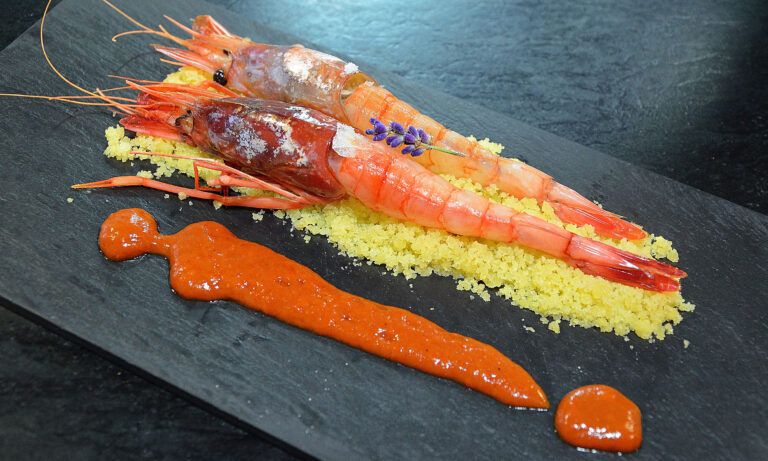
In general, eating in Agua Amarga means enjoying Mediterranean flavours, freshly caught fish and recipes that maintain the seafaring essence of the village.

Conclusion: Agua Amarga, a place to unwind
Agua Amarga is one of those places that, despite being part of a well-known natural park, retains something special: authenticity. It combines comfortable urban beaches, wild coves, volcanic viewpoints, hiking trails, villages steeped in history and captivating cuisine. But above all, it offers peace, that treasure that is increasingly difficult to find.

If you want to discover one of the most beautiful and relaxed corners of Almería, Agua Amarga awaits you with its white streets, turquoise sea and nature that seems to come from another time.
Photo Credits
Below are the photo credits in order of appearance. Royalty-free photos will not be listed below:
- Cover Image: Ziegler175, CC BY-SA 4.0, via Wikimedia Commons
- Olivier.simoen, CC BY-SA 4.0, via Wikimedia Commons
- Luis Rogelio HM, CC BY-SA 2.0, via Wikimedia Commons
- Luis Rogelio HM, CC BY-SA 2.0, via Wikimedia Commons
- Linda Hartley from UK, CC BY 2.0, via Wikimedia Commons
- Tracey Hind, CC BY-SA 2.0, via Wikimedia Commons
- Ignacio Iglesias, CC BY-SA 4.0, via Wikimedia Commons
- Linda Hartley from UK, CC BY 2.0, via Wikimedia Commons
- MdeVicente, CC BY-SA 4.0, via Wikimedia Commons
- SalyBerrea, CC BY-SA 4.0, via Wikimedia Commons
- Ignacio Iglesias, CC BY-SA 4.0, via Wikimedia Commons
- ANESTRELLA, CC BY-SA 4.0, via Wikimedia Commons
- isol, CC BY-SA 3.0, via Wikimedia Commons
- isol, CC BY-SA 3.0, via Wikimedia Commons
- José Antonio JG, CC BY-SA 4.0, via Wikimedia Commons
- No machine-readable author provided. Jorgechp assumed (based on copyright claims)., CC BY-SA 3.0, via Wikimedia Commons
- Schumi4ever, CC BY-SA 4.0, via Wikimedia Commons
- Sofía Cos, CC BY-SA 3.0, via Wikimedia Commons
- Varondán, CC BY-SA 4.0, via Wikimedia Commons
- Audalix, CC BY-SA 4.0, via Wikimedia Commons
- Audalix, CC BY-SA 4.0, via Wikimedia Commons
- Ismael Olea, CC BY 4.0, via Wikimedia Commons
- User: Benreis at wikivoyage shared, CC BY-SA 3.0, via Wikimedia Commons
- 3rik A., CC BY 4.0, via Wikimedia Commons
- Gabriel Villena from Albacete, España, CC BY 2.0, via Wikimedia Commons
- Josef Papi, CC BY-SA 4.0, via Wikimedia Commons
- Josi, CC BY-SA 4.0, via Wikimedia Commons


.jpg)
.jpg)
.jpg)


.jpg)


.jpg)

