Los Hervideros, Lanzarote: the volcanic spectacle where the sea “boils” between the lava
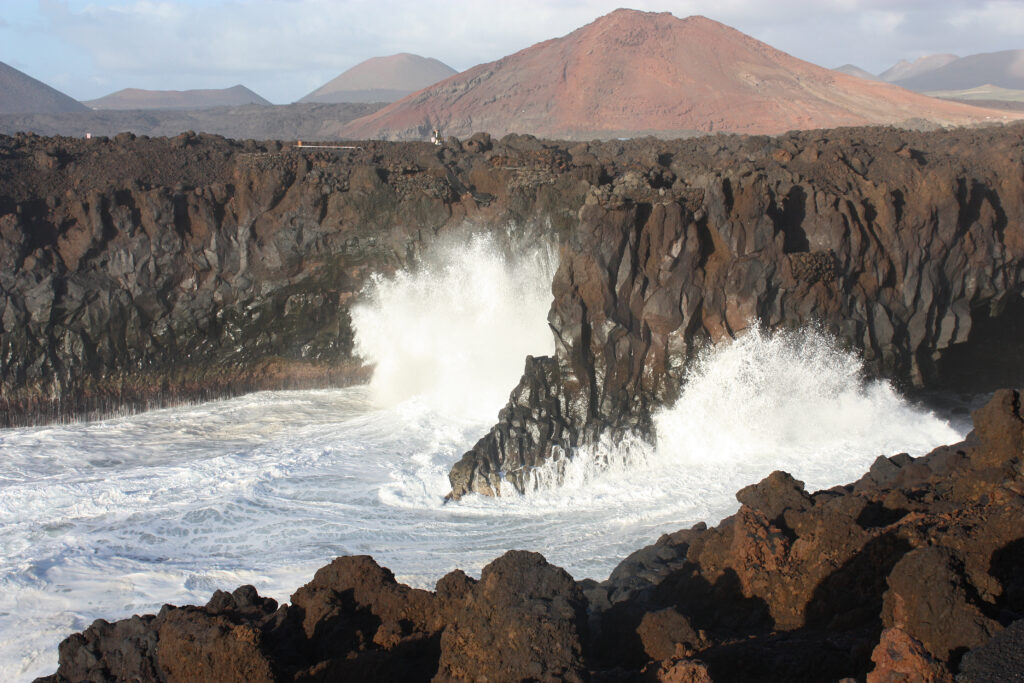
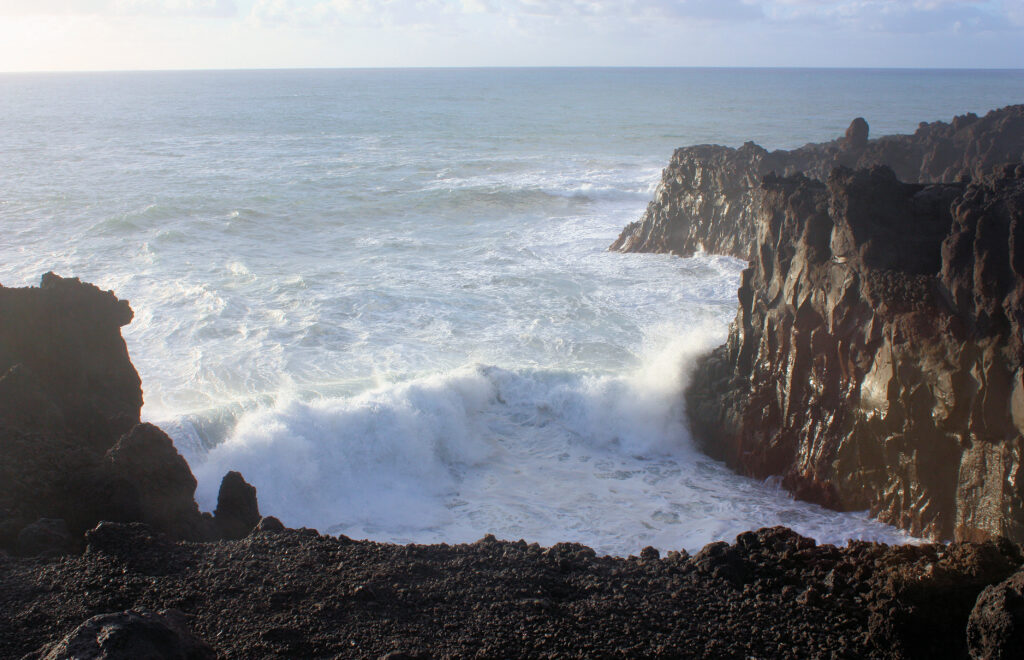
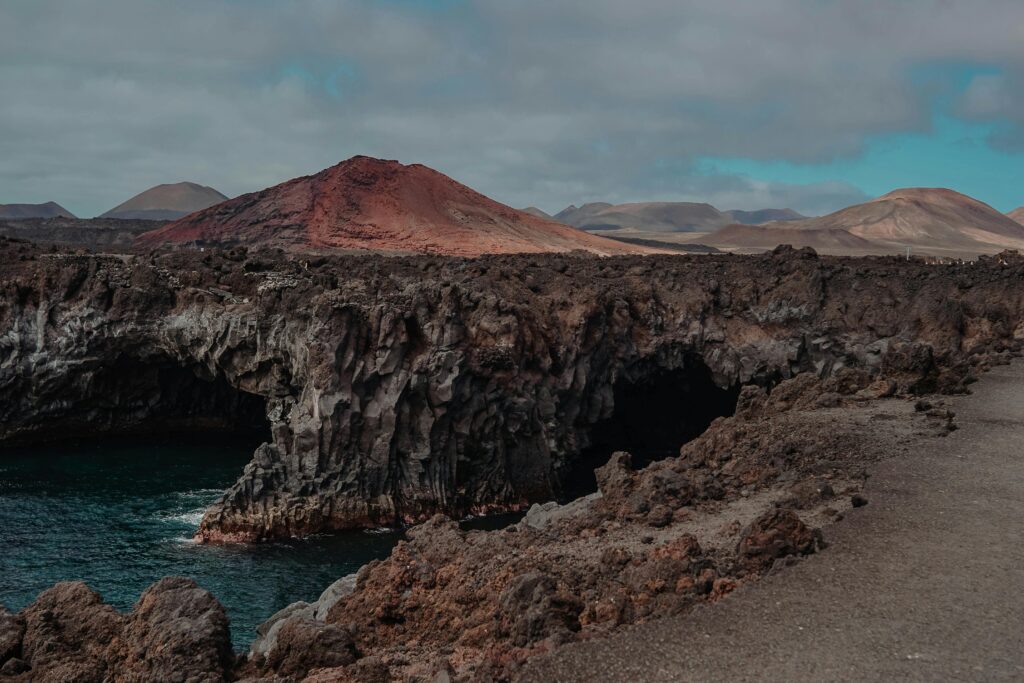
On the south-west coast of Lanzarote, where the volcanic land descends steeply into the Atlantic Ocean, lies one of the most fascinating and hypnotic landscapes on the island: Los Hervideros. These are not just cliffs or another viewpoint along the route. Here, nature has carved out a wild setting, a continuous choreography between the sea and the lava that seems to defy the laws of physics. When the waves crash with force and seep into the underground cavities, the water bursts upwards as if it were boiling. Hence its name: a place where the ocean seems to boil.
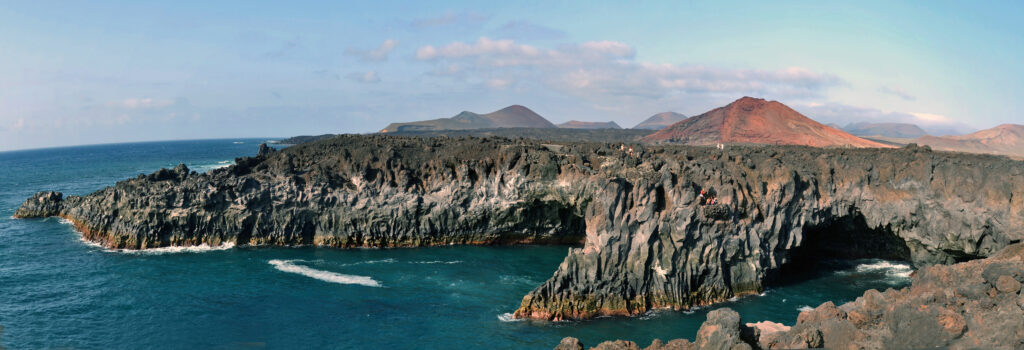
Los Hervideros is part of the most impressive landscape triangle in the south of Lanzarote: Las Salinas de Janubio, Los Hervideros and Charco Verde (Lago de los Clicos). Three very different settings, but all sharing a common origin: the intense volcanic activity that shaped the island over centuries. This stretch of coastline is perfect for understanding the essence of Lanzarote: an island that coexists with its volcanoes, wind and sea in perfect balance.
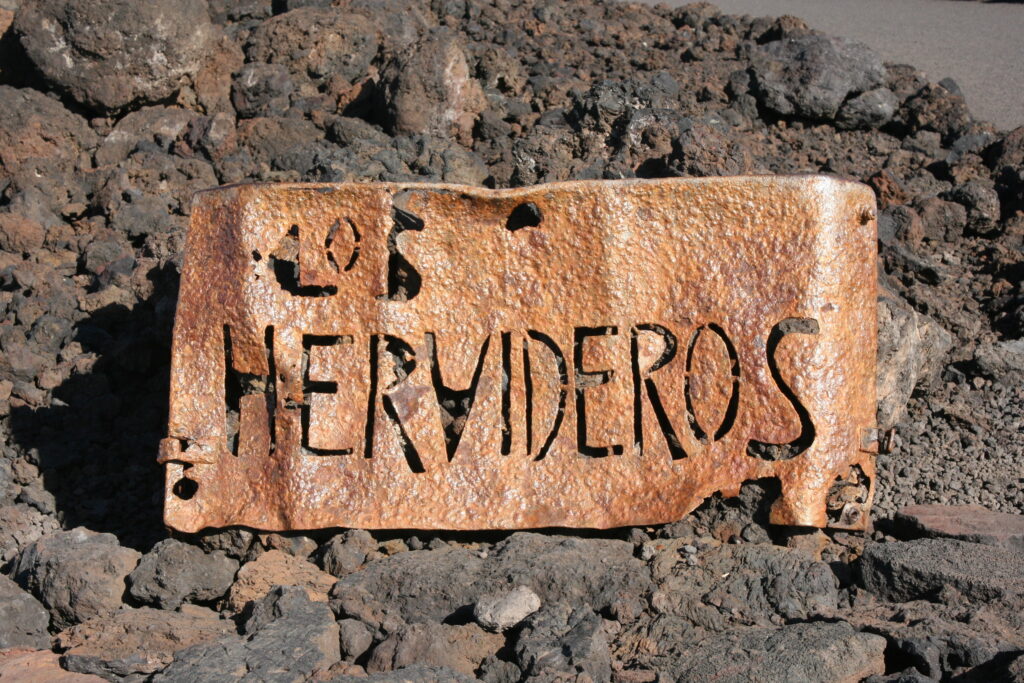
Below we explain what Los Hervideros are, why they were formed, how to visit them, the best time of day to go, and how you can combine them with other nearby places to enjoy an unforgettable route through the south-west of the island.

Volcanic origin: when lava met the Atlantic
To understand Los Hervideros, you have to travel back in time to the eruptions of Timanfaya National Park (1730–1736), one of the most intense volcanic episodes in the recent history of the Canary Islands. During those six years, huge lava flows descended the hillside and advanced towards the sea, burying ten villages and transforming the landscape of Lanzarote forever.
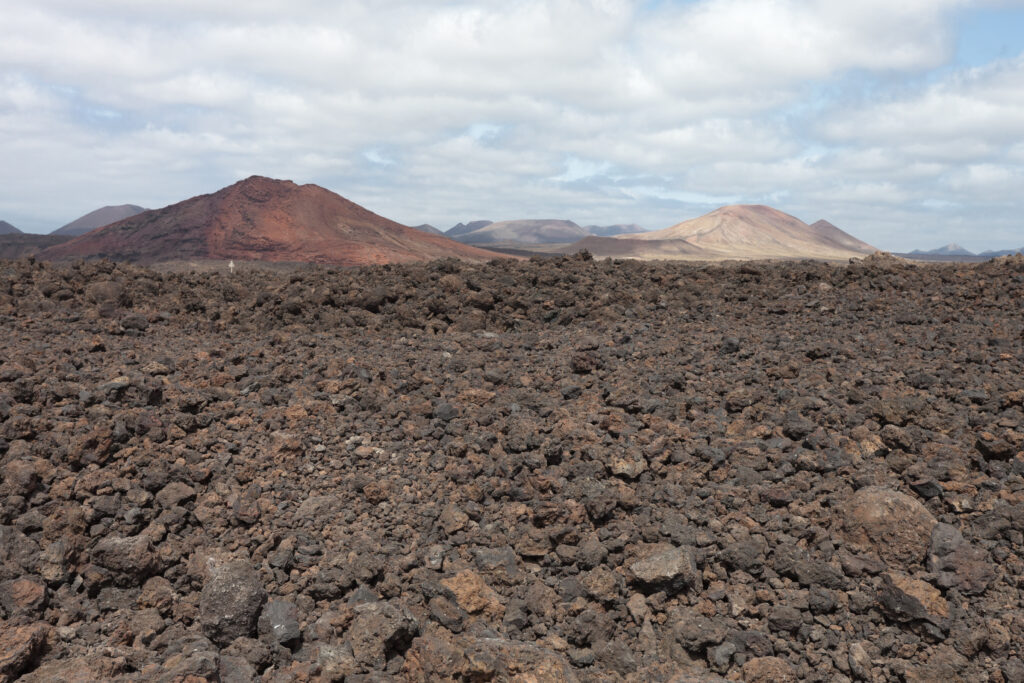
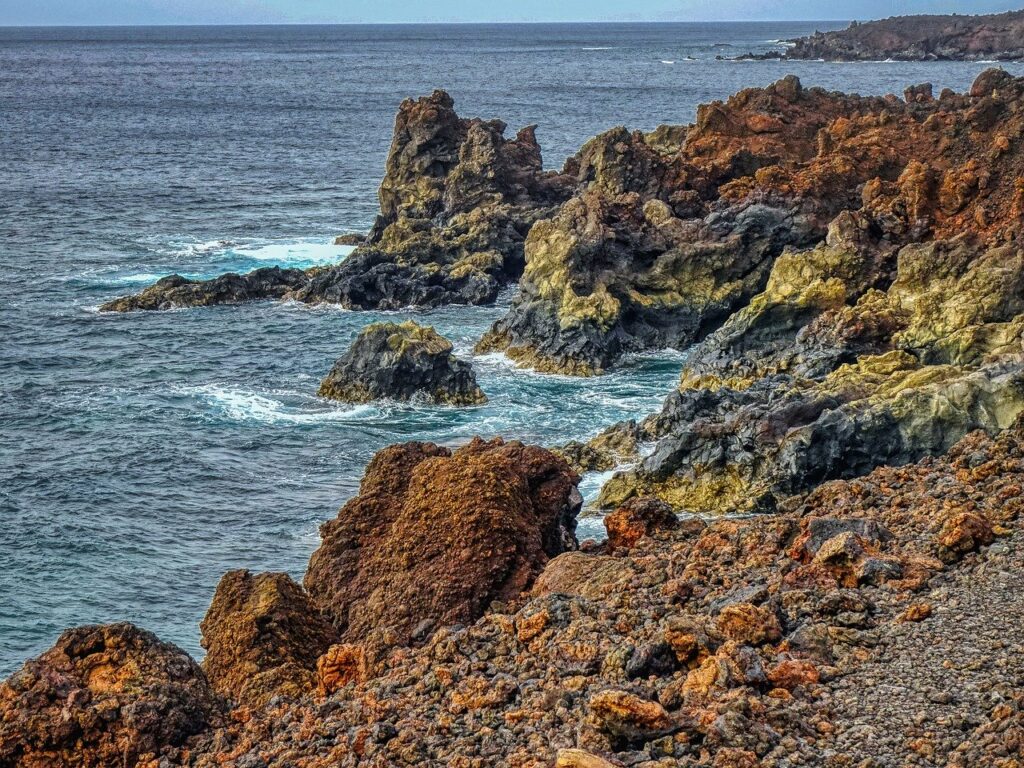
When the red-hot lava came into contact with the water of the Atlantic, the thermal shock was so sudden that it solidified immediately, creating a chaotic and twisted relief. Over time, the waves eroded these formations and carved out caves, blowholes and tunnels, giving rise to the landscape we see today.
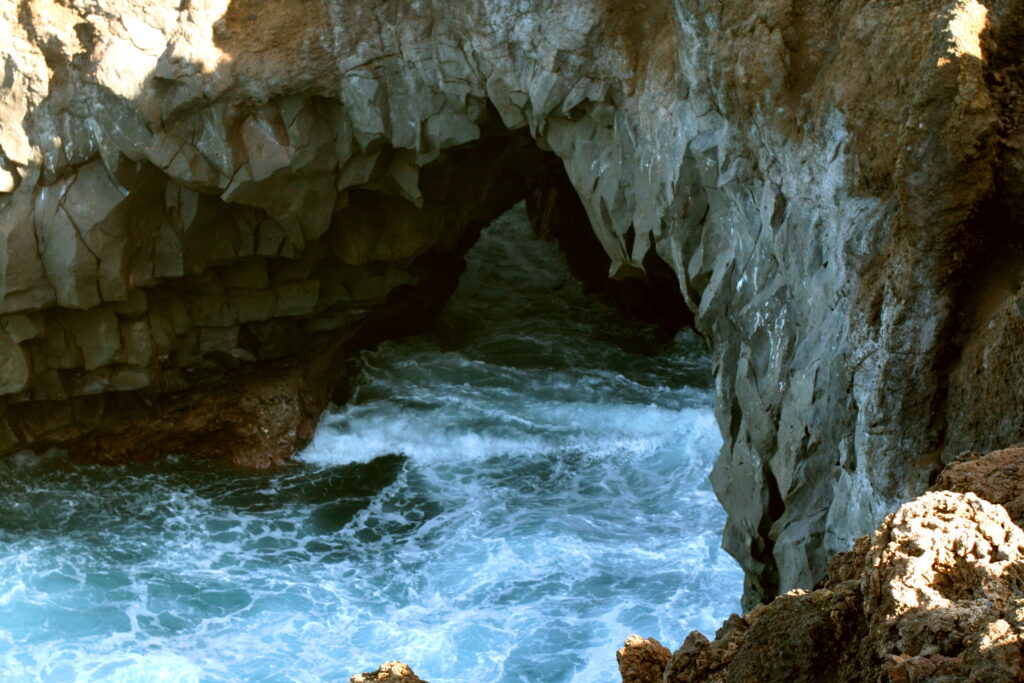
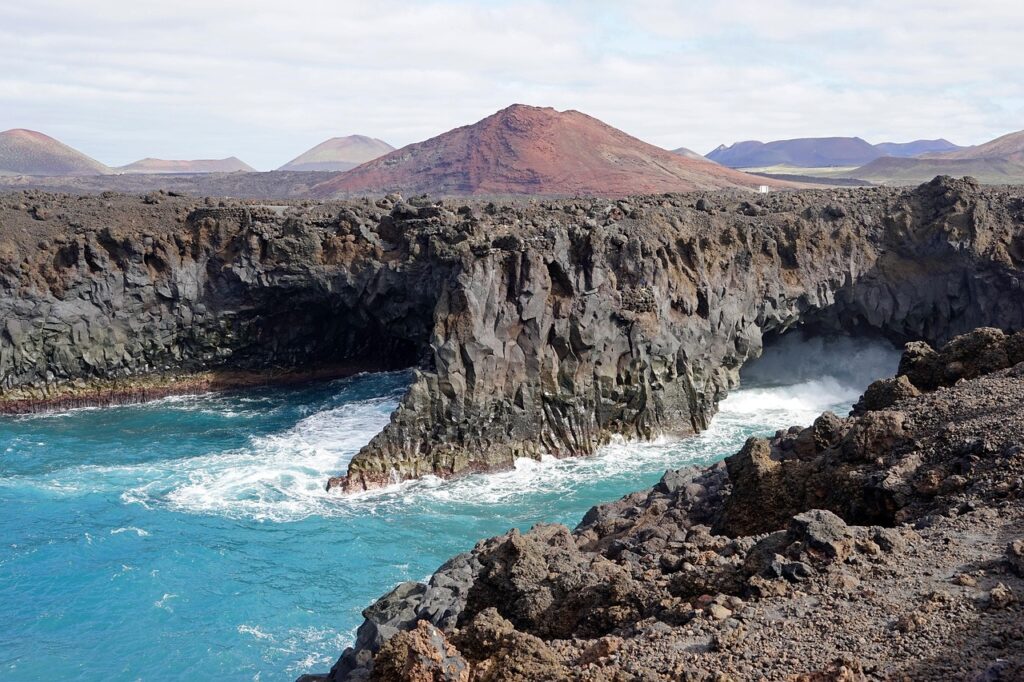
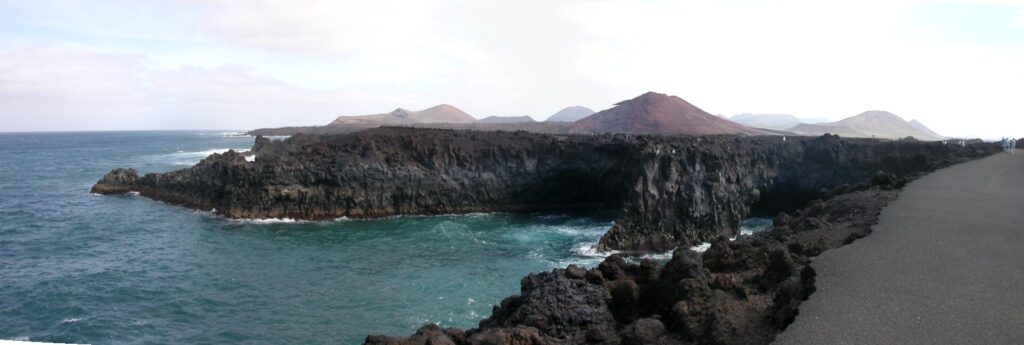
This unique process explains its appearance: sharp cliffs, fractured platforms, deep cavities and crevices that look as if they have been sculpted by hand, although it is natural forces that have shaped every inch.
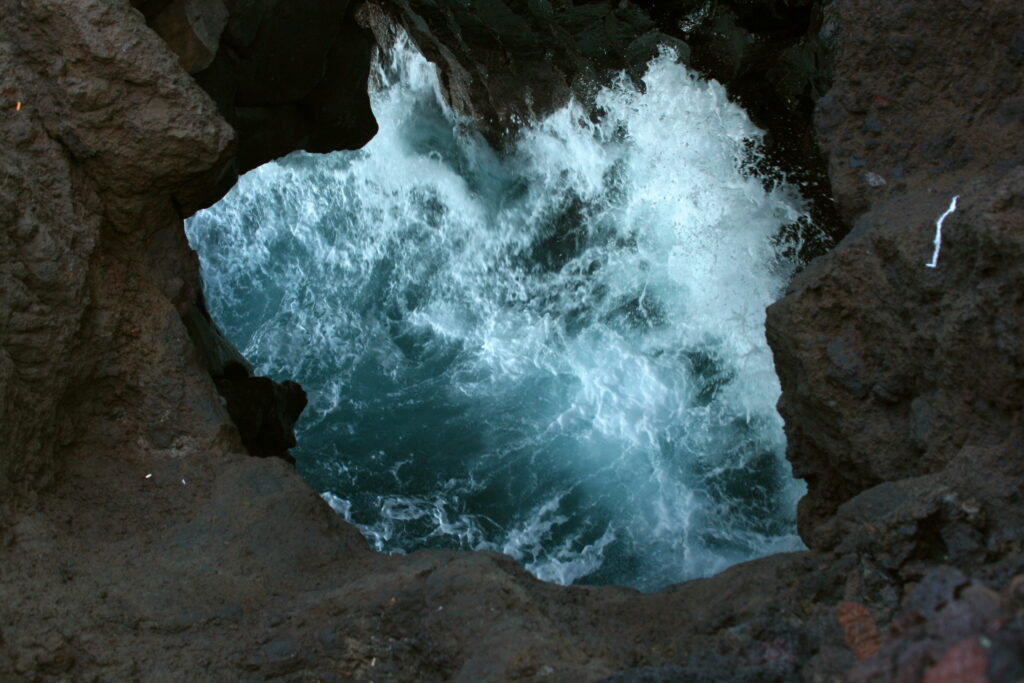
The name ‘Los Hervideros’ literally means bubbling springs, alluding to the visual effect produced when water is forcefully expelled through the vents.
Curiosities and Legacy
Los Hervideros is a recognised geological site of interest and forms part of the Lanzarote Biosphere Reserve (declared by UNESCO in 1993). The formation of caves and crevices is an example of how lava tubes (underground conduits through which lava flowed) have manifested themselves on the surface after cooling.
In addition, this landscape has served as a backdrop for cinema. In 1966, Los Hervideros was one of the natural settings used to recreate prehistoric times in the Hollywood film One Million Years B.C., starring Raquel Welch, which highlights the dramatic and timeless nature of the landscape.
A landscape in motion: the Los Hervideros experience
Visiting Los Hervideros is not about walking a long trail or observing a static monument. It is a sensory experience: noise, foam, wind, rock, light and water colliding in a continuous dialogue.
1. Viewpoints sculpted in lava
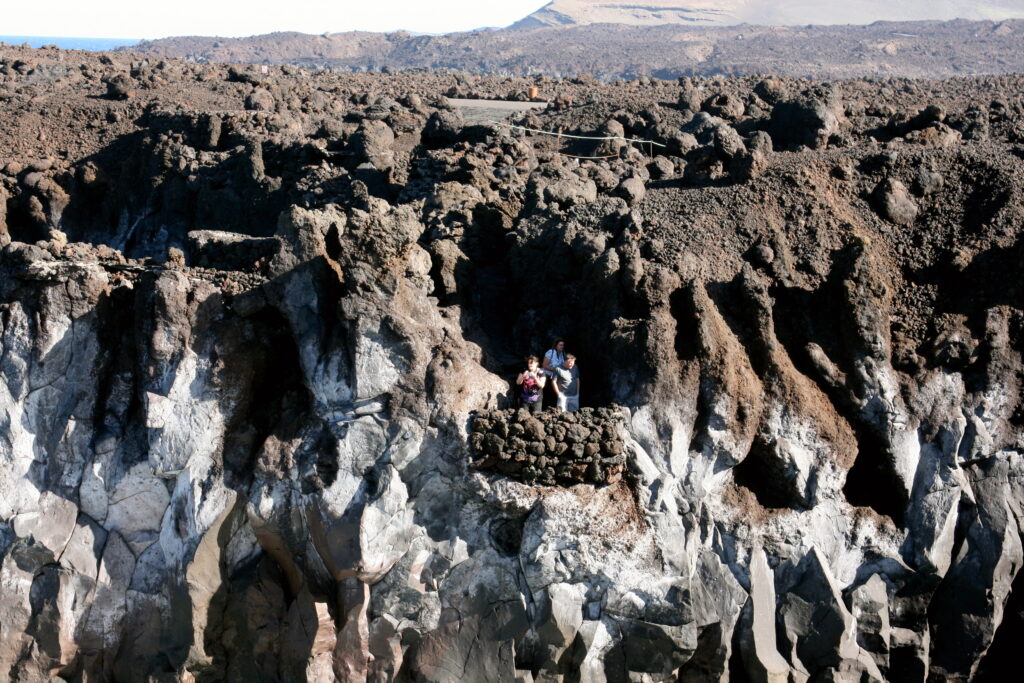
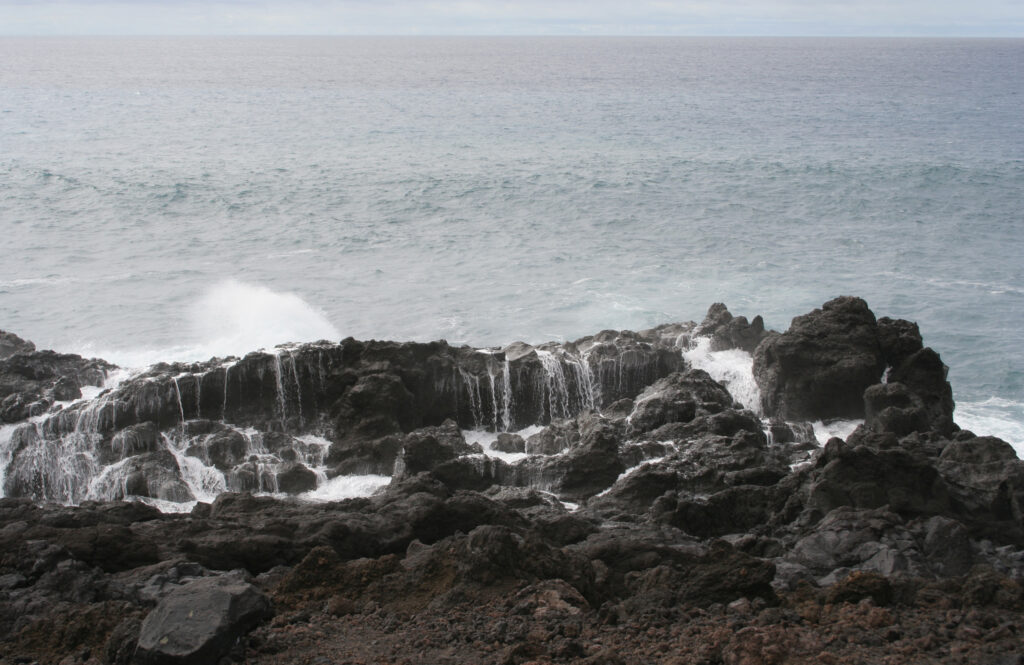
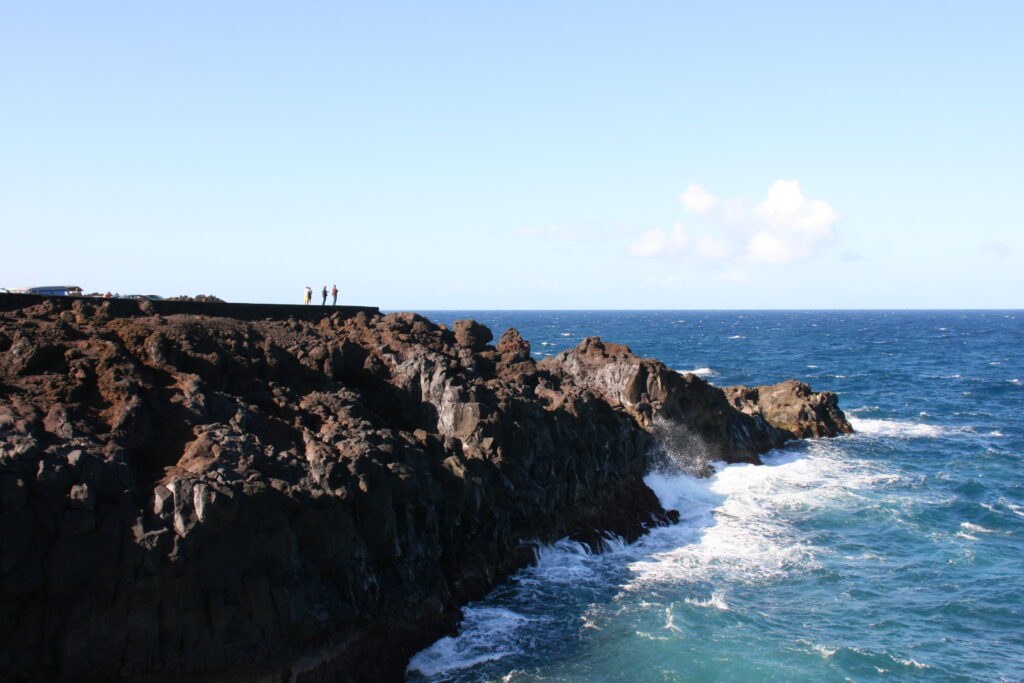
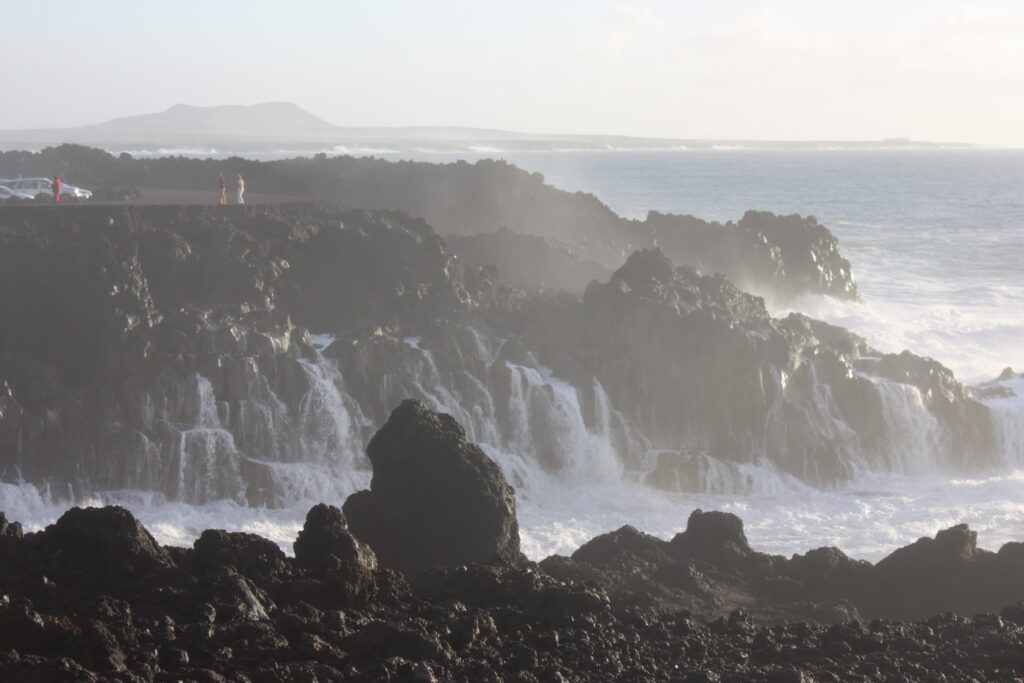
The route follows a well-marked trail that winds its way through the volcanic formations. Small balconies and platforms allow you to safely lean out and watch the sea forcefully enter the cavities. On days when the sea is rough, the waterfalls are spectacular.
2. Caves, blowholes and vents
Hidden tunnels are concealed between the black walls, where the waves disappear only to reappear seconds later in the form of foam. The sound produced—a deep roar—is reminiscent of the earth’s heartbeat.
3. Unreal colour contrasts
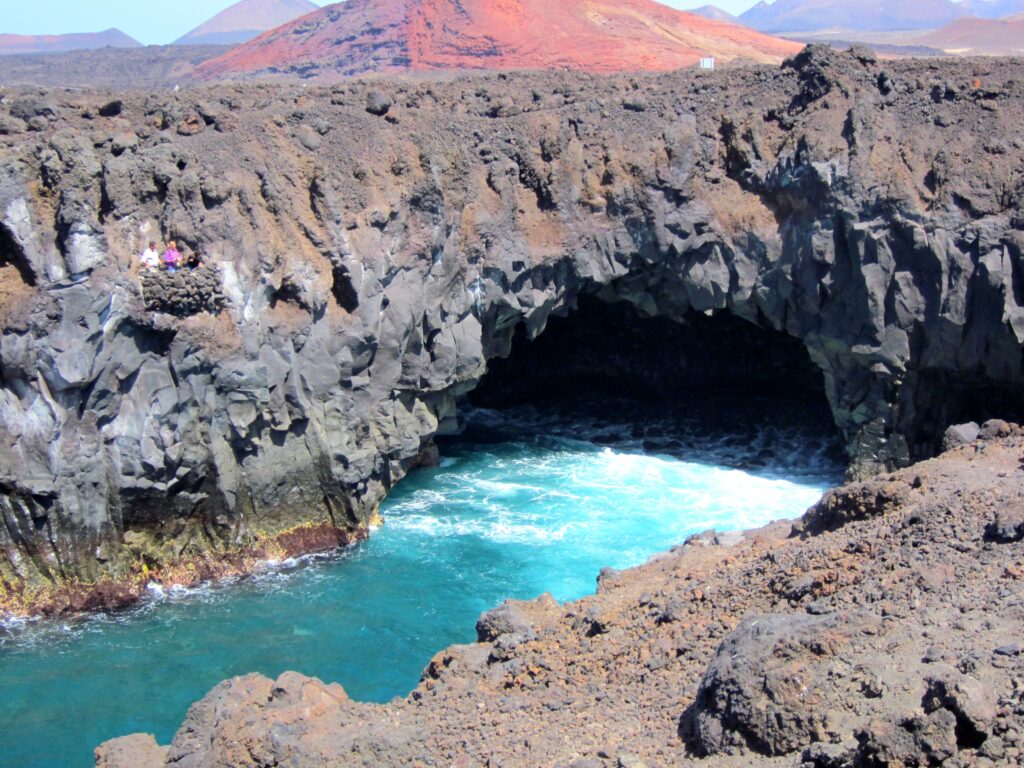
The black of the lava, the intense blue of the Atlantic and the reddish tones of Montaña Bermeja create a unique contrast. At sunset, the golden light transforms the whole scene into a changing canvas.
4. A perfect place for photography
The textures of the lava, the force of the waves and the play of shadows make Los Hervideros a paradise for photography lovers. The landscape changes every minute, inviting you to stop and observe.
Best time of day to visit
A visit to Los Hervideros is a sensory experience that depends largely on the state of the sea.
To witness the authentic ‘boiling’ effect, the key is the waves and the tide.
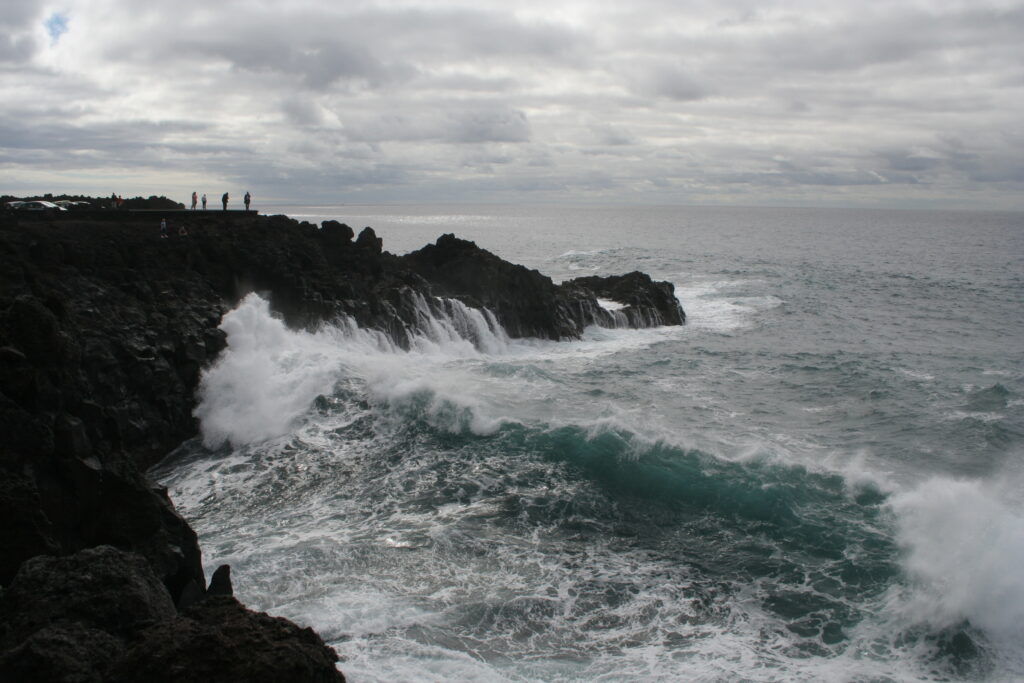
- Rough sea: Days with strong waves and swell (more common in winter) are the most spectacular. This is when the roar of the sea becomes deafening and the columns of salt water reach their maximum height, giving visitors a dose of adrenaline as they feel the untamed power of nature.
- High or Medium-High Tide: The combination of rough seas and a rising or peak tide maximises the force with which the water is pushed into the cavities, intensifying the spectacle.
- Light Contrast: The sunset is undoubtedly the most photogenic moment. The golden light enhances the dramatic contrast between the intense black of the volcanic rock and the deep blue of the Atlantic, tinging the landscape with magical tones.
What is the route like? Accessibility and safety
The site is perfectly adapted for a safe and accessible visit. A path marked out with picón (volcanic ash) and various stairways allow visitors to enter and descend to several artificial balconies and natural viewpoints.
It is vital to stay strictly within the areas marked and protected by railings. The force of the Atlantic at this point is uncontrollable and the terrain, even on calm days, is uneven and slippery.
Warning from The Kompasse: Los Hervideros is not a swimming area. Observation is the only objective. Resist the urge to stray from the paths or turn your back to the sea when taking photographs.
The visit is relatively short, around 20 to 40 minutes, but it is recommended that you take the time to stop, listen to the deep beat of the sea echoing in the caves and admire the sculptural details of the lava.
Trail characteristics
- Compact lava terrain and firm cinder.
- Stone steps to access the viewpoints.
- Handrails at the most exposed points.
- Well-defined trail with stones and walkways.
Safety
- Never stray from the marked paths.
- Some areas appear accessible, but the rock is sharp and uneven, and the sea can be rough.
- Do not turn your back on the ocean while taking photos.
- Keep a constant watch on children: on days when the sea is very rough, choose the viewpoints with railings.
- This is not a swimming area and you should not go down onto the rocks.
To avoid crowds
- Early in the morning.
- Or just before sunset.
- Weekdays and non-holidays.
To see them at their most spectacular
- Medium or high tide.
- Moderate or high waves.
When both factors coincide, the blowholes expel columns of water with enormous power and the spectacle is incredible.
For photography
- Sunset: the warm light accentuates the textures of the lava and the contrast with the sea.
- Trade wind days: they generate sea mist that adds drama to the images.
Services available (and not available)
Los Hervideros is a pure natural space. Do not expect tourist facilities.
There are no:
- Toilets
- Bars or cafés
- Shaded areas
- Information offices
You should bring:
- Water
- Sunscreen
- Closed-toe shoes
- Windbreaker (on days with strong trade winds)
- Camera or charged mobile phone
For any additional services, simply head to El Golfo or the viewpoints at Janubio.
Where they are and how to get there
Los Hervideros is located in the municipality of Yaiza, between Las Salinas de Janubio and the coastal village of El Golfo. Access is easy and well signposted by road.
Approximate distances
- Playa Blanca → Los Hervideros: 20–25 min (16–18 km)
- El Golfo → Los Hervideros: 5–10 min (3–5 km)
- Puerto del Carmen → Los Hervideros: 35–40 min
- Arrecife or Airport (ACE) → Los Hervideros: 40–45 min
- Costa Teguise → Los Hervideros: 40 min
Recommended road routes
- From Playa Blanca: LZ-2 towards Yaiza → turn off onto LZ-703 ‘El Golfo / Los Hervideros’.
- From Arrecife or the airport: LZ-2 towards Yaiza → turn off onto LZ-703.
- From Timanfaya: take the LZ-67 down to Yaiza and join the LZ-703.
Parking
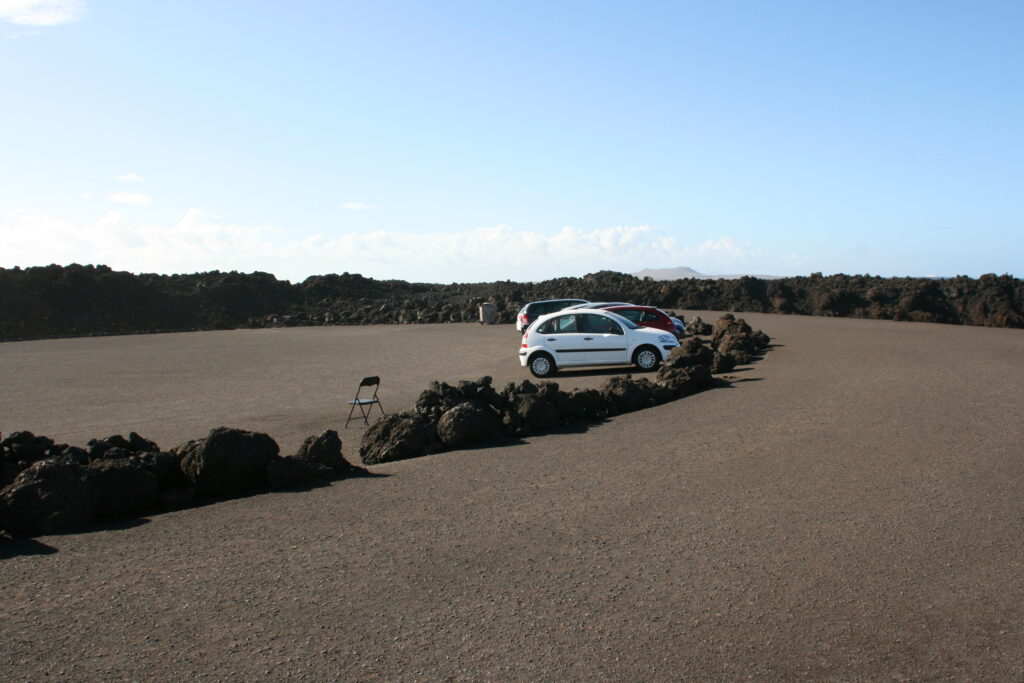
There is a free car park next to the start of the trail. Turnover is high—visits usually last between 20 and 45 minutes—so even if you see cars there, it doesn’t usually take long for a space to become available.
Tip: Do not leave valuables in plain sight in your car.
What to see nearby: the best route through the south-west of Lanzarote
Los Hervideros is part of a very comprehensive route that you can do in half a day or a morning. Here’s how to make the most of it.
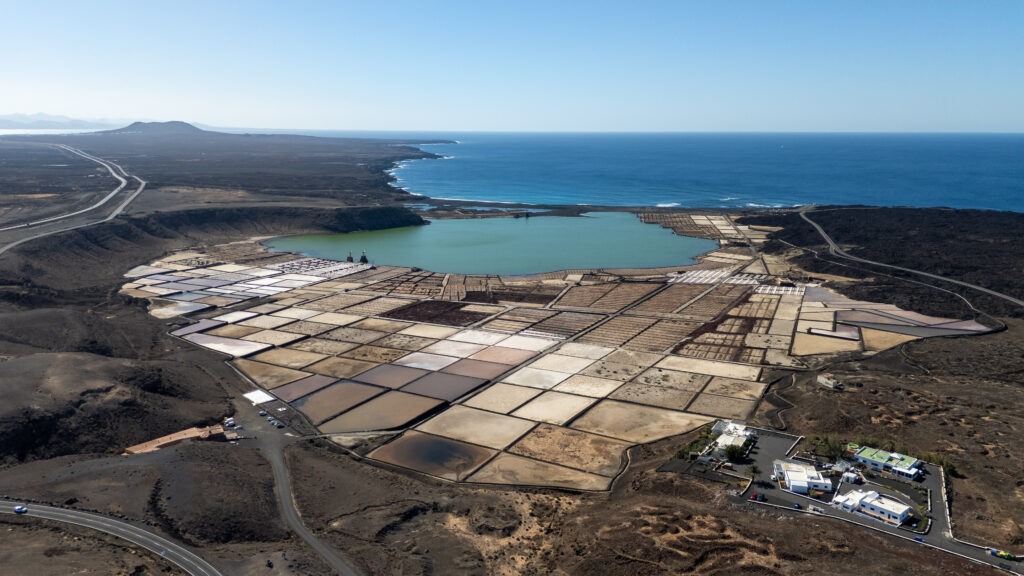
1. Janubio Salt Flats
Located south of Los Hervideros, the Janubio Salt Flats are the largest active salt flats in the Canary Islands and one of the most iconic sights on the island.
- Interest: In addition to their photographic value, they represent an important cultural and economic heritage, maintaining a tradition of artisanal salt extraction that dates back more than a century.
- Landscape: A vast expanse of geometric ponds where seawater evaporates to extract salt. The landscape is a fascinating palette of colours ranging from the pure white of the salt to the ochre, pink and reddish tones of the pools, which are especially beautiful at sunset.
2. Charco Verde (Lake of the Clicos)
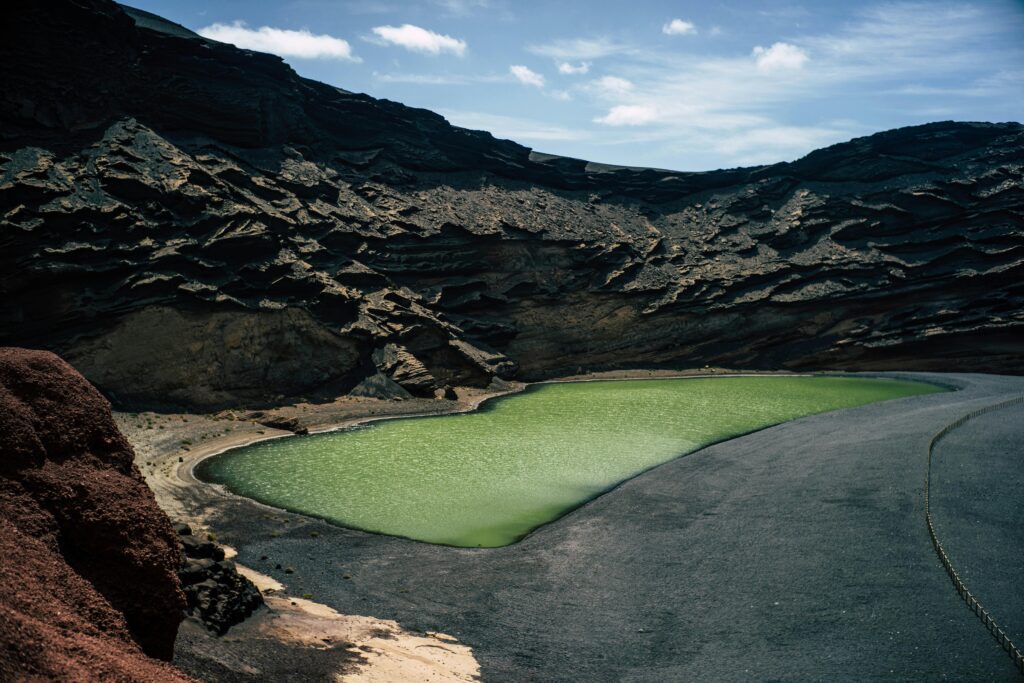
To the north, just 3-5 kilometres away, in El Golfo, this geological wonder is located.
- The Phenomenon: This is a small lagoon of seawater that has acquired a striking intense emerald green colour. This unusual hue is due to the high concentration of phytoplankton and microfauna that has colonised its waters.
- The Contrast: Charco Verde is located within a semi-submerged volcanic crater, where the vibrant green of the lagoon contrasts dramatically with the black sand of the beach and the rusty red of the rocks of the volcanic cone that surrounds it.
3. Other Nearby Points of Interest
- Risco Beach: one of the wildest, most beautiful, and memorable beaches in Lanzarote.
- Las Grietas: A perfect blend of geology, volcanic landscape, and photogenic appeal that attracts more and more travelers.
- Los Charcones: a string of unspoilt natural pools stretching along the south-western coast of the island.
- Punta Mujeres: a small fishing village where the ocean ebbs and flows at will, forming dozens of natural pools.
- Caleta del Mojón Blanco: a small natural treasure where turquoise waters and ocean calm prevail.
- Tahíche: Together with the César Manrique Foundation, this is probably the most important cultural space in the whole of Lanzarote.
Practical recommendations:
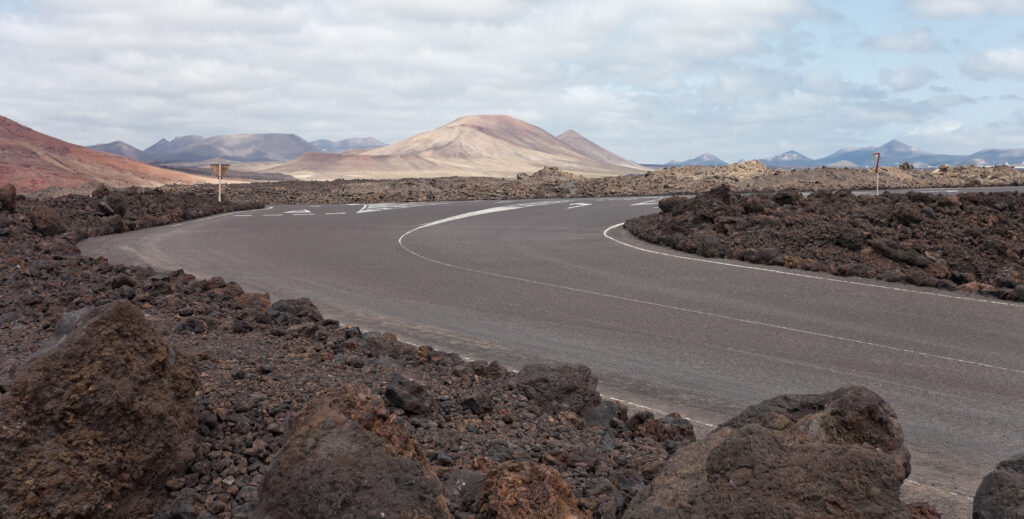
- Footwear: It is essential to wear closed, comfortable footwear with good soles, suitable for walking on uneven terrain of picón and stone.
- Equipment: Sun protection, a hat and a windbreaker, as the Alisio wind and sea spray are common.
- Children: The visit is suitable for children, but maximum supervision is required and they must be held by the hand, especially on days when the sea is rough, giving priority to viewpoints with railings.
- Sustainability: This is a protected natural area, part of the Biosphere Reserve. It is crucial to stay on the paths, leave no litter behind and do not alter the landscape (do not collect stones or build what are popularly known as ‘towers’).
Frequently asked questions
How much does it cost to enter?
It is completely free. There are no turnstiles, tickets or reservations.
How much time do I need?
Between 20 and 45 minutes, depending on your pace and the waves.
Is it accessible for children?
Yes, but always under supervision. There are exposed areas where it is essential to be vigilant.
When is the best time of year to visit?
Any time of year is a good option, but in winter and spring the waves tend to be more intense.
Can you get there by public transport?
No. The only way is by hire car, your own vehicle or taxi.
Conclusion: a must-see on your trip to Lanzarote
Los Hervideros is not just a point on the map: it is a powerful reminder of the island’s volcanic origins. A place where you can experience geology, where the wind blows in your face, where the sea roars and where the landscape seems to be in perpetual creation. No artifice, no barriers, no excessive tourist exploitation.
If you are looking for an authentic experience, a landscape that makes you stop and observe without rushing, or if you simply want to feel Lanzarote in its purest form, Los Hervideros is a must-see.
The Janubio – Hervideros – El Golfo triangle sums up in just a few kilometres everything that makes Lanzarote so appealing to travellers: strength, untamed nature and volcanic beauty.
Photo Credits
Below are the photo credits in order of appearance. Royalty-free photos will not be listed below:
- Rolfcosar, CC BY-SA 4.0, via Wikimedia Commons
- Frank Vincentz, CC BY-SA 3.0, via Wikimedia Commons
- Luis Miguel Bugallo Sánchez (Lmbuga), CC BY-SA 3.0, via Wikimedia Commons
- Frank Vincentz, CC BY-SA 3.0, via Wikimedia Commons
- Dguendel, CC BY 4.0, via Wikimedia Commons
- Frank Vincentz, CC BY-SA 3.0, via Wikimedia Commons
- Frank Vincentz, CC BY-SA 3.0, via Wikimedia Commons
- Rebexho, CC BY-SA 3.0, via Wikimedia Commons
- Tony Hisgett from Birmingham, UK, CC BY 2.0, via Wikimedia Commons
- Tony Hisgett from Birmingham, UK, CC BY 2.0, via Wikimedia Commons
- Frank Vincentz, CC BY-SA 3.0, via Wikimedia Commons
- Dguendel, CC BY 4.0, via Wikimedia Commons
- Frank Vincentz, CC BY-SA 3.0, via Wikimedia Commons
- MiljenkoSuljic, CC BY-SA 4.0, via Wikimedia Commons
- Luis Miguel Bugallo Sánchez (Lmbuga), CC BY-SA 3.0, via Wikimedia Commons
- Dguendel, CC BY 4.0, via Wikimedia Commons


.jpg)
.jpg)


